
OIML BULLETIN - 2026 - VOLUME LXVII - NUMBER 2
f o c u s p a p e r
The digital tachograph
An alternative analysis of the uncertainty of the calibration process
Giuseppe Ardimento
Head of Market Regulation, Naples Chamber of Commerce, Italy
Citation: G. Ardimento 2026 OIML Bulletin LXVII(2) 20260211
Introduction
The digital tachograph is an electronic device installed in commercial vehicles, such as trucks and buses, designed to automatically record driving times, speed, distance covered, and rest periods of the driver. Its primary purpose is to ensure road safety by preventing driver fatigue and to guarantee fair competition within the transport industry by enforcing compliance with social regulations [1].
Since its introduction as a mandatory requirement in the European Union in 2006, the digital tachograph has replaced the older analogue systems (paper charts). It operates by storing encrypted data on the vehicle unit’s internal memory and on individual driver cards.
With the introduction of Smart Tachographs in recent years, the system now also utilizes GPS positioning and dedicated short-range communication (DSRC) for remote inspections by law enforcement authorities.
The calibration process for a digital tachograph
Some definitions
For a correct calibration of the device, three quantities are fundamental: time, the constant k of the digital tachograph, and the vehicle constant w.
The digital tachograph determines time using high-precision oscillators, ensuring that the measurement of time intervals is free from significant error. We therefore consider the measurements of the time intervals as having negligible error, and a negligible contribution to the uncertainty of the calibration process.
The value of the digital tachograph (expressed in impulses per kilometre) is a device characteristic and is fixed (typically around 8000 imp/km). The relevant OIML Recommendation, R 55 [2], specifies that the speedometer constant shall be the impulse frequency (expressed in impulses per minute) when the speedometer indicates 60 km/h, which makes the numerical value of the speedometer constant equal to the odometer constant k of the tachograph. In the calibration process, the correct determination of the condition for measuring k is thus equivalent to the correct calibration of the speedometer. The proof of this fact follows from the consideration that

Thus, at the speedometer constant, the speedometer will indicate a speed of 60 km per hour.
The vehicle constant w is the characteristic quantity showing the number of impulses emitted by the device provided on the vehicle, for connection to the tachograph odometer, when the vehicle covers a distance of 1 km. The vehicle constant has the same dimensions as the tachograph k. The vehicle constant w essentially depends on the vehicle load, the dimensions, the pressure and the degree of wear of the tyres. It must be determined under standard test conditions (see point 4.2.4 of [2]).
Intuitively, for a correct calibration of the tachograph, w must be equal to k.
The measurement equation
Considering the fact that the major source of errors is the determination of the constant w defined above, the error on the distance indicated by the device against the real distance covered by the vehicle can be written as follows:
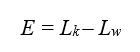
where Lk and Lw are, respectively, the distance indicated by the tachograph e and the distance effectively covered by the vehicle, when both are driven by the same impulse train representing the distance covered by the vehicle. For an impulse train of N pulses, we can write
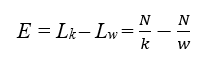
At the value w0 at which the calibration error is zero, the error E, for a deviation Δw can be written as follows:
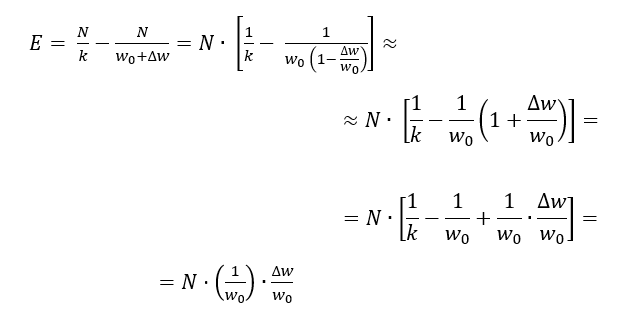
The relative error for the distance covered, from equation (3), because N/w0 = Lw, can thus be written as
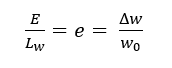
Therefore, the relative error in the distance traveled by the vehicle is equal to the relative deviation of the vehicle constant from the value corresponding to the zero-error condition/
Alternative analysis of the uncertainty of the calibration process
The evaluation of the calibration uncertainty of the tachograph's w-constant, upon which its accuracy essentially depends, is typically carried out in a challenging measurement environment, such as a mechanical assembly or repair workshop. Consequently, the controlled conditions of a laboratory are difficult to achieve. For this reason, the calibration uncertainty is evaluated using an approach where the various uncertainty components are summed linearly rather than quadratically; the different contributions are therefore considered fully correlated, thus accounting for the worst-case scenario of their interaction. This constitutes an alternative evaluation of calibration uncertainty, as it deviates from the principles usually established by current literature on uncertainty calculation (where uncertainty components are typically treated as uncorrelated).
The author of this document is a senior electronic engineer who graduated before the GUM (Guide to the Expression of Uncertainty in Measurement) [4] and other foundational documents on uncertainty evaluation were developed. Therefore, the “alternative” method of uncertainty calculation consists of applying the differentiation of Equation 4 not through differential analysis, but by evaluating the expanded calibration uncertainty as the difference between the maximum and minimum possible values of the tachograph’s w-constant. Obviously, the unilateral range of the expanded uncertainty can be considered as being a half of the difference between the maximum and the minimum value of w. Consequently, algebraic concepts are employed while differential analysis is not taken into consideration. The result achieved is identical to that obtained by applying differential analysis.
Use of the alternative method to determine the tachograph’s w-constant expanded uncertainty
The maximum and the minimum values for w can be written as follows:
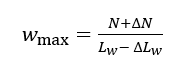
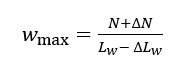
and
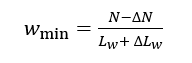
where N is the number of impulse train which drives the tacograph, Lw is the distance covered by the vehicle, ΔN of the number of impulses and ΔLw is the deviation of the distance covered.
Given the definitions reported above, the one-sided expanded uncertainty Δw can be estimated as half the difference between the wmax and wmin values
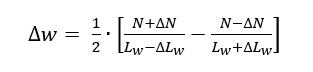
Rearranging and considering that infinitesimals of order higher than the first can be neglected, equation (7) can be written as follows:
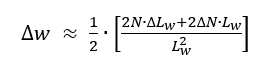
From equations (4) end (8), we can then express as follows the relative error e in the distance covered by the vehicle::
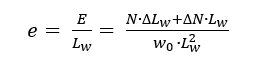
Considering that w0 = N/Lw, equation (9) can be rewritten as

From equation (10) we can estimate the maximum relative error in the calibration process of the tachograph. From OIML R 55 [2], the maximum error of the odograph is 4%: thus the calibration process must guarantee that the error in the equation (10) is less than 4%/3 = 1.33%.
Example based on the typical calibration process used by the mechanical assembly or repair workshop
In this section, we show that the condition
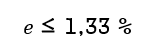
is satisfied, using a legal linear measure and making appropriate considerations on the pulse counting error at the device.
In Eq. (10), considering the overall error ΔLw in the distance covered can be expressed as a function of the error on the linear measure used for the determination of the ground contact patch of the tyre circumference Elm, the distance Lw and the tyre circumference C.
The overall error on the distance covered can be written as follows:
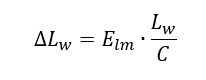
which can be written as
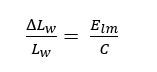
Using (12), eq. (10) can be rewritten as follows:
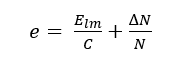
The second term in eq. 10’ becomes smaller as N increases Thus, where the simulated test distance becomes conveniently great, the only term affecting the overall error is the first one:
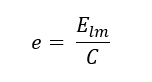
Thus e only depends on the error of the linear measure and on the ground contact path of the tyre.
The error regarding the transmission of the pulses governing the device can be estimated as half a pulse over the total number of pulses constituting the transmitted signal train.
Typical values in the calibration process are:
- Elm = 10 mm (since the scale interval of a Class II linear measure is 1 mm and the error is also almost 1 mm on the value of 3 m; as a precaution, the error is assumed to be 2 mm for C = 3 000 mm, considered as the average tyre circumference)
- ΔN = 1/2 (the error in detecting the impulse train from the pulse transmitting device)
- N = 8 000 (the number of impulses typically corresponding to the distance of 1 km)
Considering the equality in (12) and the above-reported values, equation (10), yields e = 0.07%. Thus, the condition (11) is satisfied.
Conclusions
This analysis demonstrates that under challenging conditions, such as those found in mechanical workshops accredited for tachograph calibration, even assuming a linear combination of the primary error sources in the calibration process, the overall uncertainty remains well below the limit of 1/3 of the MPE (Maximum Permissible Error). Consequently, when calibrating tachographs with standard equipment, these uncertainty sources can be considered negligible.
References
[1] Regulation (EU) No 165/2014; Regulation (EC) No 561/2006; Directive 2006/22/EC
[2]OIML R 55:1981 Metrological and technical requirements for speedometers, mechanical and electrical tachographs and chronotachographs for motor vehicles
[3] MID (Measuring Instruments Directive 2014/32/EU): Annex IX – Material measures of length and multidimensional measuring instruments (MI-008)
[4] UNI CEI ENV 13005/2000 Guida all'espressione dell'incertezza di misura