
OIML BULLETIN - 2026 - VOLUME LXVII - NUMBER 2
f o c u s p a p e r
Reliability of Essential Climate Variables
Uncertainty in Sea Surface Temperature and Its Impact on Derived Climate Monitoring Products
Momoe Yoshida  1, Blake L. Spady 2, 3, 1, Andy Harris 4, Scott F. Heron 1
1. Physical Sciences, College of Science and Engineering, James Cook University  , Australia
2. Global Science and Technology, LLC , USA
3. U.S. National Oceanic and Atmospheric Administration (NOAA), National Environmental Satellite Data and Information Service, Center for Satellite Applications and Research , Coral Reef Watch, USA
, USA
Citation: M. Yoshida, B.L. Spady, A. Harris and S.F. Heron 2026 OIML Bulletin LXVII(2) 20260203
1. Importance of uncertainty for climate research and sustainability applications
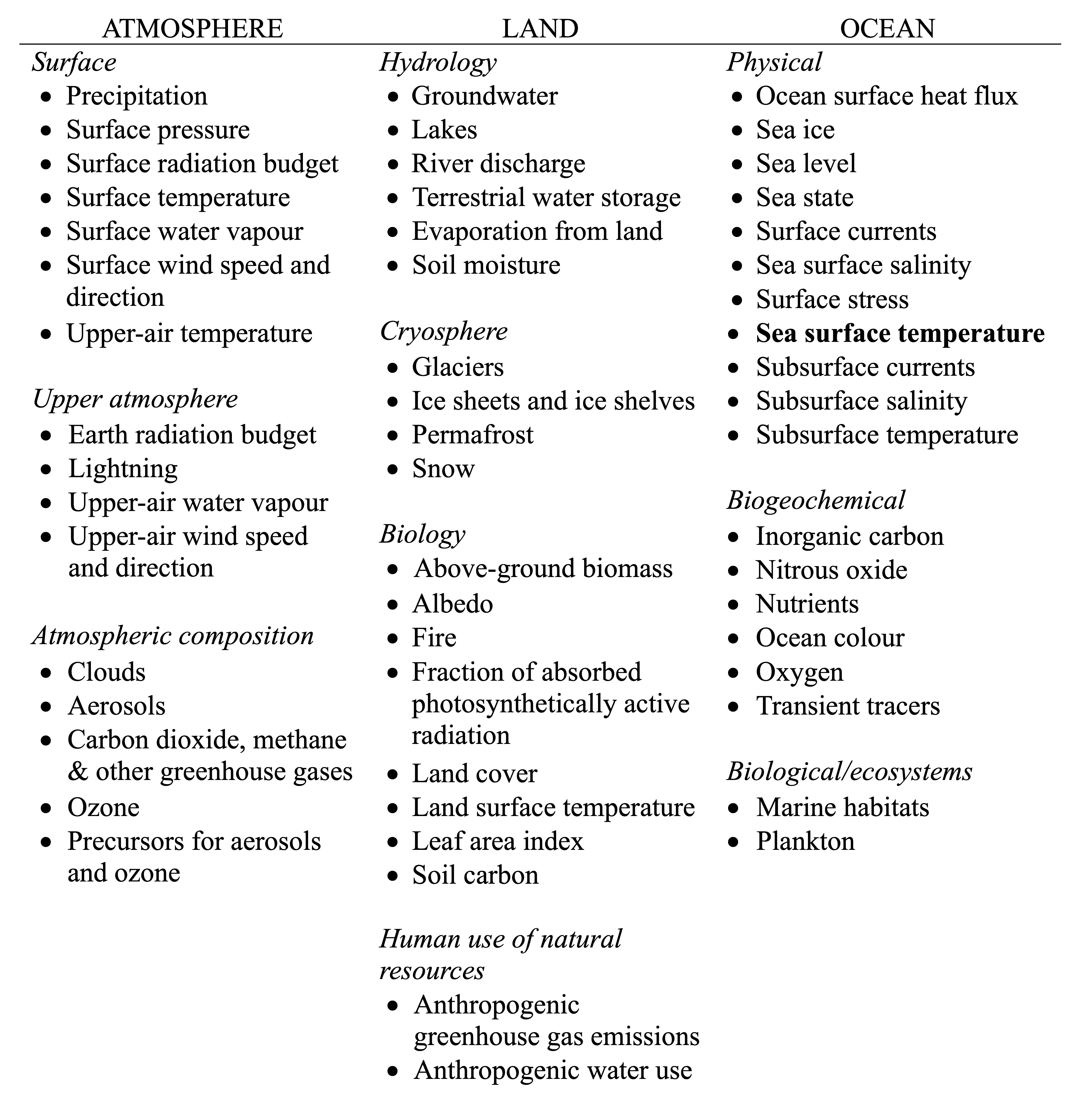
Understanding uncertainty in observational data is important for climate research and action. Robust quantification of uncertainty is essential to the credibility of climate science, particularly where observational datasets underpin attribution studies, model evaluation and decision-making frameworks [1]. The Global Climate Observing System (GCOS) specifies 55 Essential Climate Variables (ECVs; Table 1) that are important for describing the physical, chemical and biological state of the atmosphere, land and ocean – and therefore for understanding and monitoring Earth’s climate system [2, 3].
Uncertainty in ECVs arises from different types of sources, including measurement capability (e.g., sparse coverage, insufficient spatial and temporal resolution associated with in situ and remote sensing platforms and sensors), assumptions introduced by data processing algorithms (e.g., in quality control, bias correction and estimation of missing data) and regional environmental biases (e.g., atmospheric effects including cloud contamination in satellite observations). These sources can interact in non-linear ways, making it difficult to isolate their individual contributions and increasing the complexity of uncertainty in downstream products. These interactions can lead to compounded uncertainties that are not well represented by simple error metrics [4, 5].
Identifying these uncertainty sources and distinguishing their individual contributions is necessary to quantify the magnitude of their impacts on ECVs and on climate monitoring products derived from them. This knowledge also helps to determine which sources most strongly influence the reliability of final outputs. However, the underlying uncertainty in ECV products is complex and not easily understood – some end-users may apply these data without full consideration of their inherent uncertainty. This disconnect between data producers and end-users can lead to overconfidence in derived indicators, particularly when uncertainty is not clearly communicated. This issue has been widely recognised in climate services, where usability and interpretation of uncertainty information remain key barriers to effective uptake [6, 7].
Table 1. List of 55 Essential Climate Variables (ECVs) specified by the Global Climate Observing System (GCOS), highlighting sea surface temperature (the focus of this paper).
2. Sea surface temperature as a key climate variable
To illustrate the importance of understanding uncertainty for climate applications, this paper focuses on a key oceanic ECV, sea surface temperature (SST), and climate monitoring products derived from it. SST is widely used in climate research, product development and sustainability applications, including the assessment of ocean warming due to climate change and the monitoring and prediction of climate variability, such as El Niño–Southern Oscillation [8], Indian Ocean Dipole [9] and Atlantic Multi-decadal Oscillation [10]. Beyond contributing to an improved understanding of large-scale climate processes, SST is also critical for regional and ecosystem-scale applications, including general circulation models, numerical weather prediction systems, marine heatwave (MHW) and heat stress monitoring, fisheries management and coastal hazard assessment [11]. Variability and extremes in SST affect marine ecosystems, influencing the health and distribution of corals, seagrasses, algae and other marine species and habitats [12, 13, 14]. These can also increase the risk of outbreaks (e.g., of disease in seastars [15] and sea lice infestations [16]), with cascading effects on marine food webs, fisheries and aquaculture [13].
Climate applications most commonly rely on satellite-derived Level 4 (L4) SST products, the highest SST processing category, that provide spatially and temporally replete global SST fields (Figure 1) suitable for long-term analyses. These products are typically generated through merging multi-sensor satellite observations and, potentially, in situ measurements. Data gaps due to cloud cover or quality control and other processing decisions are resolved through interpolation and data assimilation techniques [4, 17]. The transformation from Level 2 swath data to Level 4 analysed fields (Figure 1) involves multiple algorithmic choices that can influence both the magnitude and structure of uncertainty in the final product [4, 5]. While L4 SST products offer substantial advantages in always providing information in all locations, the processing required to achieve these characteristics introduces additional layers through which underlying uncertainties will inevitably be propagated that must be carefully understood when interpreting derived climate indicators.
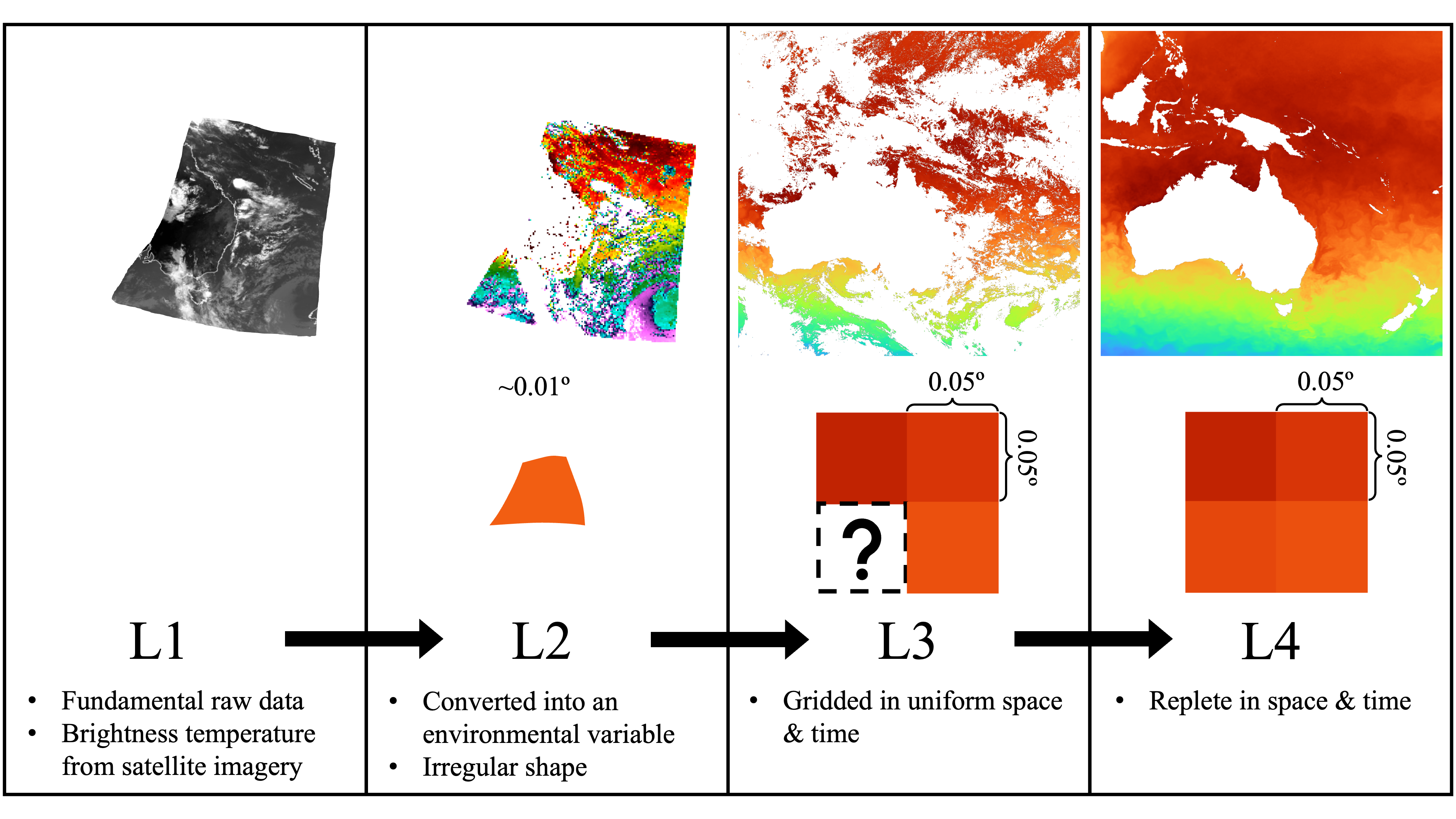
Figure 1. Description and examples of Level 1 (L1) to Level 4 (L4) satellite-derived sea surface temperature (SST) products for the Australian region. L1 raw data are converted into geophysical variables at L2, then gridded to uniform spatial and temporal resolution at L3 and gap-filled in space and time at L4. L2 pixels have irregular shapes (orange polygon) due to satellite motion and viewing angle in the context of the Earth’s curvature. L3 and L4 pixels are shown as rectilinear (as for a flat-Earth projection; e.g., Mercator). L3 products are generated from a single swath (“uncollated”), multiple swaths from a single sensor (“collated”) or multiple swaths from multiple sensors (“super-collated”) but still contain spatial and temporal gaps. L4 products provide spatially and temporally complete SST fields. (sources: EUMETView for L1, https://view.eumetsat.int/productviewer?v=default; NASA EARTHDATA SEARCH for L2, https://search.earthdata.nasa.gov/search; authors’ data for L3–L4)
3. Uncertainty sources in satellite-derived L4 SST products
L4 SST products are subject to multiple sources of error that arise at different stages of the data processing chain and contribute to overall uncertainty. Here, we refer to ‘error’ as the deviation from the true value, while ‘uncertainty’ describes the estimated magnitude and structure of that error. These errors may be separated into uncorrelated (random) and correlated components (including systematic biases and structured errors) [4, 5]. Uncorrelated uncertainties originate from sources such as radiometric noise in satellite observations (especially when propagated through retrieval algorithms) [18], for which the magnitude of uncorrelated error decreases when multiple observations are averaged during gridding and compositing [4]. Correlated uncertainties arise from factors such as: sensor calibration errors; residual cloud contamination; exclusion of colder SST values as a consequence of cloud detection processes; assumptions in quality-control and bias-correction procedures; and errors in the background prior SST fields (e.g., warm bias due to exclusion of colder SST values) [18, 19]. SST retrieval algorithms themselves may also result in correlated errors on synoptic atmospheric scales since, although they are developed to obtain SST under a range of conditions, residual biases will exist if the atmospheric state differs from the ensemble used to derive the coefficients [20].
Some L4 SST products blend satellite and in situ measurements, which can introduce correlated errors due to differences in spatial representation (point-based in situ measurements versus area-averaged satellite observations where within-pixel spatial patterns are persistent) and temporal sampling (due to differences in measurement frequency, observation interval and diel cycles). These systematic errors (biases) are often spatially and temporally structured and cannot simply be reduced by averaging; they can be particularly problematic as they may propagate through the processing stages and produce locally correlated or large-scale structured biases in the final SST fields. Such structured errors are especially relevant for climate applications that rely on anomaly detection, trend estimation or threshold exceedance, where even small biases can lead to systematic misinterpretation.
In addition, the observing system used to monitor ocean temperature has evolved substantially over time. Early ship-based bucket measurements in the late nineteenth century have been replaced by modern underway measurement systems and complemented with in situ observing networks and multi-sensor satellite platforms. Changes to the characteristics of uncertainty through time have been apparent with the evolution of sensor technology, improved spatial and temporal coverage, and increased data density.
4. Improved reliability information for downstream climate products
Confidence in climate products derived from SST should be improved through greater understanding and communication of uncertainty in the SST values. Many L4 SST products do not explicitly characterise the magnitude and spatio-temporal correlation of errors, nor do they distinguish the contributions of individual error sources. Comprehensive uncertainty characterisation requires access to intermediate variables generated during the L4 processing that contain additional information from the analysis process and are typically not retained due to their large size and storage constraints. To address this limitation, a user-oriented reliability metric could be developed that is based on this additional information. Such a metric would distinguish areas and periods of higher and lower confidence in SST values and could be designed for integration into downstream climate monitoring products derived from L4 SST.
Investigating downstream implications of SST reliability for derived monitoring products requires understanding of how these products are calculated. For instance, the MHW algorithm defines a period during which SST exceeds a seasonally varying threshold (the 90th percentile) for at least five consecutive days ([21]; Figure 2). Anomalously warm SST periods have been linked to rapid and widespread ecological changes, including shifts in species distributions, mortality of key habitat-forming organisms, alterations in ecosystem structure and functioning, and consequential impacts on fisheries, biodiversity and ecosystem services [22]. Two seasonally-varying MHW thresholds are determined using a daily SST climatology (daily mean and 90th percentile; Figure 2); uncertainty in SST across multiple years can influence the value of these thresholds. Additionally, each individual SST value (A in Figure 2) carries an associated uncertainty that is compared with the 90th percentile value (B in Figure 2). As a result, the combination of these uncertainties can influence the occurrence and detected duration of MHW events, which in turn can affect the predicted likelihood and severity of impacts on marine ecosystems. For example, underprediction of an SST value to be just below the 90th percentile threshold (red star in Figure 2) could prematurely end an MHW period.
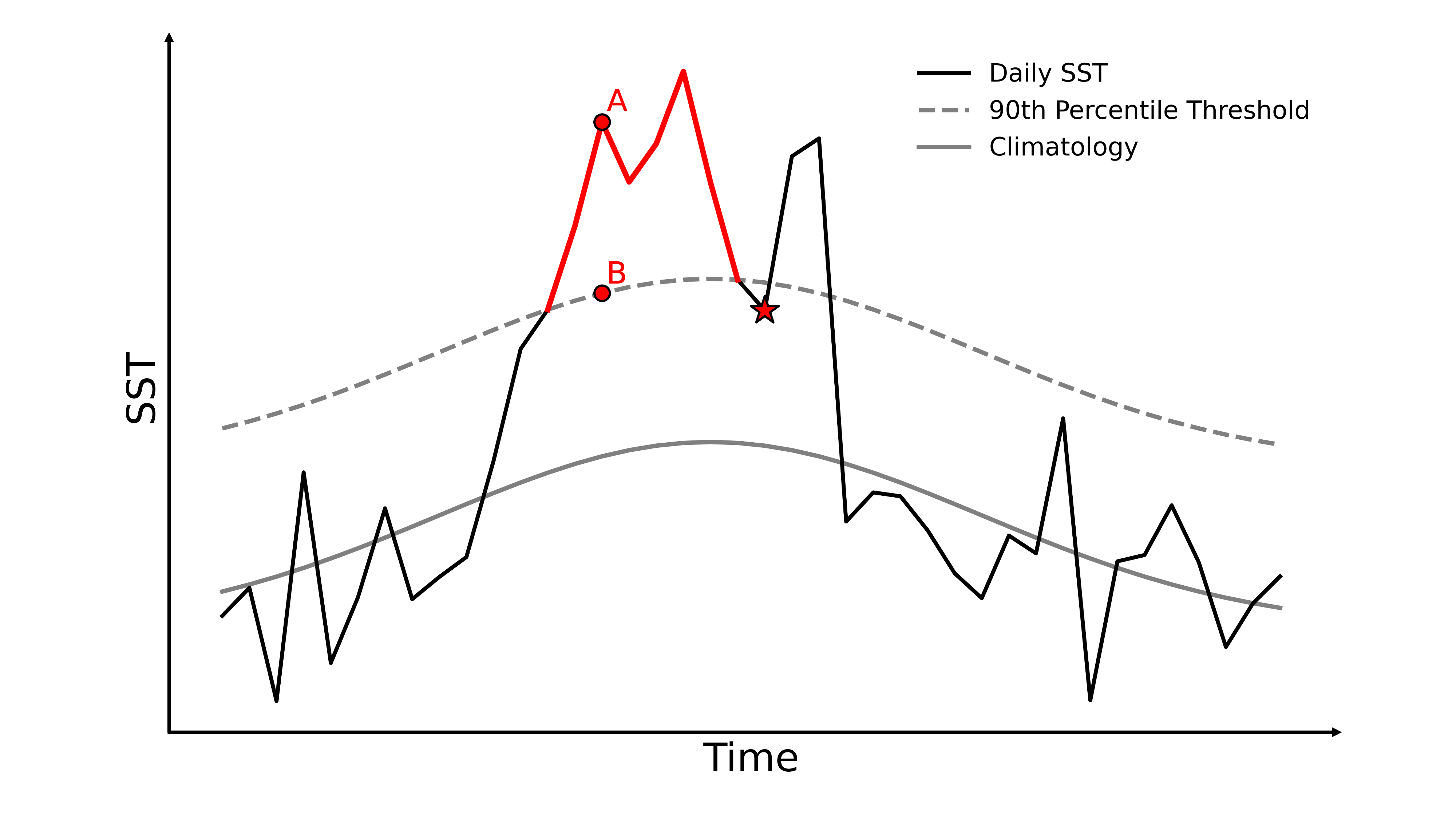
Figure 2. Schematic of a marine heatwave (MHW, red line), adapted from Hobday et al. (2016). The daily value of sea surface temperature (SST, solid black), 90th percentile threshold (grey dashed) and daily climatological mean (grey solid) are used to determine the occurrence of MHW, noting the duration must be at least five days. Uncertainties associated with the daily SST (A) and 90th percentile threshold (B) have the potential to influence the definition and/or duration (e.g., underprediction of SST or overprediction of 90th percentile at the red star could have prematurely ended the detected MHW.
Degree Heating Week (DHW) quantifies accumulated heat stress specific to coral reefs to predict mass bleaching and mortality ([23]; Figure 3). Coral bleaching events can devastate coral reef ecosystems, which support high biodiversity, protect coastlines from erosion and provide food and livelihoods for billions of people [24]. DHW is calculated as the accumulation of SST anomalies above the climatological maximum monthly mean (MMM) that are 1 ℃ or greater over a 12-week (84-day) rolling window [25]. Errors in SST values close to the threshold (indicated by the red circle and square in Figure 3) could affect the calculated DHW.
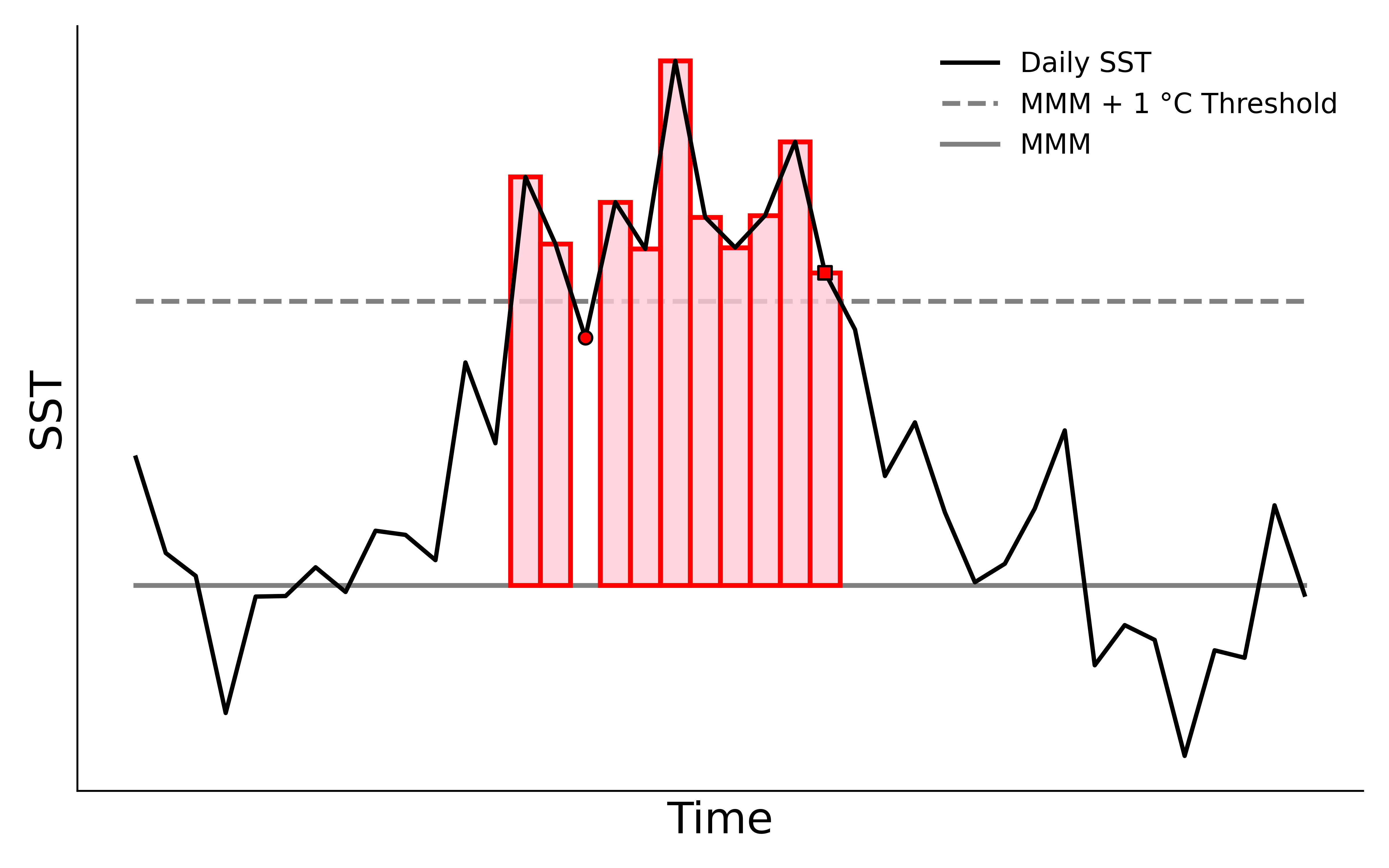
Figure 3. Schematic of the Degree Heating Week (DHW) calculation for accumulated heat stress as produced by NOAA Coral Reef Watch. Daily sea surface temperature (SST) values (black solid) are compared with the climatological maximum monthly mean (MMM; grey solid) and bleaching threshold (MMM + 1 ℃; grey dashed) to predict ecological response. Daily contributions to heat stress (red rectangles) are accumulated across a 12-week rolling window when SST exceeds the bleaching threshold. Uncertainties associated with the daily SST and MMM have the potential to influence the DHW accumulation; e.g., underprediction of SST or overprediction of the threshold could reduce the calculated DHW (red circle), whilst the converse could inflate the value (red square).
In threshold-based systems, including MHW and DHW, even small biases (systematic error) and/or uncertainties in SST can lead to differences in event classification, particularly if they are near threshold boundaries. For the DHW, the accumulation of SST anomalies with small errors can sum to have larger, influential differences (i.e., for predictions of bleaching severity and mortality). This sensitivity is amplified in regions with high natural variability or limited observational coverage, where uncertainty in the SST value and/or baseline climatology may be substantial [21, 26]. Therefore, incorporating improved reliability information for L4 SST products could enhance assessments of heat stress, enabling more informed, data-driven conservation and management decisions.
5. Decision support and use for other ECV applications
Propagation of uncertainties should also be undertaken for other ECVs, especially where uncertainties in the primary observations may influence derived climate monitoring products used in operational decision-making. These include early-warning systems for environmental hazards and decision-support frameworks underpinning a wide range of climate-sensitive applications, including fisheries management, agricultural planning, water resource allocation, coastal zone monitoring, ecosystem conservation and disaster risk reduction [27]. Inadequate characterisation of observational uncertainty can reduce the efficacy of and trust in warnings, assessments and long-term evaluations that support climate action and sustainability planning.
Transparent characterisation of uncertainty enables end-users to better interpret spatially- and temporally-varying data and derived monitoring products, supporting more informed use in climate research and sustainability applications. Improved transparency is particularly important for operational and policy-informing applications of key climate variables. This allows ECV users to explicitly account for uncertainty in decision-making frameworks, improving the robustness and reliability of climate-informed actions.
Understanding and clearly quantifying uncertainty in ECV products is therefore critical to ensure that derived climate indicators can be used with confidence in scientific, operational and policy applications. More broadly, this aligns with emerging efforts in Earth observation to provide uncertainty-aware products that effectively support decision-making [28]. Improving the accessibility, interpretability and integration of uncertainty information into downstream products represents a key opportunity to enhance the robustness and usability of climate services.
Addressing this need will require closer collaboration between data producers, algorithm developers and end-users to ensure that uncertainty information is both scientifically rigorous and practically actionable. This is of heightened importance during the present era of rapid climate change.
Acknowledgements
Funding support for this work was through the Australian Research Council, DP230102986 (SFH); and through the National Oceanic and Atmospheric Administration (NOAA) under ST133017CQ0050_1332KP22FNEED0042 (BLS) and NA24NESX432C0001 (AH). The scientific results and conclusions, as well as any views or opinions expressed herein, are those of the author(s) and do not necessarily reflect the views of NOAA or the Department of Commerce.
References
[1] IPCC, Climate Change 2021: The Physical Science Basis. Contribution of Working Group I to the Sixth Assessment Report of the Intergovernmental Panel on Climate Change, [V. Masson-Delmotte, P. Zhai, A. Pirani, S.L. Connors, C. Péan, S. Berger, N. Caud, Y. Chen, L. Goldfarb, M.I. Gomis, M. Huang, K. Leitzell, E. Lonnoy, J.B.R. Matthews, T.K. Maycock, T. Waterfield, O. Yelekçi, R. Yu, and B. Zhou (eds.)], Editor. 2021: Cambridge University Press, Cambridge, United Kingdom and New York, NY, USA.
[2] Bojinski, S., et al., The concept of essential climate variables in support of climate research, applications, and policy. Bulletin of the American Meteorological Society, 2014. 95(9): p. 1431-1443.
[3] GCOS, The Global Observing System for Climate: Implementation Needs. 2016.
[4] Embury, O., et al., Satellite-based time-series of sea-surface temperature since 1980 for climate applications. Scientific Data, 2024. 11(1): p. 326.
[5] Merchant, C.J., et al., Satellite-based time-series of sea-surface temperature since 1981 for climate applications. Scientific Data, 2019. 6(1): p. 223.
[6] Hewitt, C., S. Mason, and D. Walland, The global framework for climate services. Nature Climate Change, 2012. 2: p. 831-832.
[7] Vaughan, C. and S. Dessai, Climate services for society: origins, institutional arrangements, and design elements for an evaluation framework. Wiley interdisciplinary reviews. Climate Change, 2014. 5(5): p. 587-603.
[8] Deser, C., et al., Sea surface temperature variability: Patterns and mechanics. Annual Review of Marine Science, 2010. 2: p. 115-143.
[9] Saji, N.H., et al., A dipole mode in the tropical Indian Ocean. Nature, 1999. 401(6751): p. 360-363.
[10] Knight, J.R., et al., A signature of persistent natural thermohaline circulation cycles in observed climate. Geophysical Research Letters, 2005. 32(20): L20708.
[11] O’Carroll, A.G., et al., Observational needs of sea surface temperature. Frontiers in Marine Science, 2019. 6: 420.
[12] Poloczanska, E.S., et al., Global imprint of climate change on marine life. Nature Climate Change, 2013. 3(10): p. 919-925.
[13] Smale, D.A., et al., Marine heatwaves threaten global biodiversity and the provision of ecosystem services. Nature Climate Change, 2019. 9(4): p. 306-312.
[14] Kessler, A., N. Goris, and S.K. Lauvset, Observation-based sea surface temperature trends in Atlantic large marine ecosystems. Progress in Oceanography, 2022. 208: 102902.
[15] Eisenlord, M.E., et al., Ochre star mortality during the 2014 wasting disease epizootic: role of population size structure and temperature. Philosophical Transactions of the Royal Society of London. Series B. Biological Sciences, 2016. 371(1689): 20150212.
[16] Montes, R.M., R.A. Quiñones, and C. Gallardo-Escárate, Disentangling the effect of sea temperature and stocking density on sea louse abundance using wavelets in a highly infested salmon farming area. Aquaculture, 2022. 546: 737246.
[17] Maturi, E., et al., A new high-resolution sea surface temperature blended analysis. Bulletin of the American Meteorological Society, 2017. 98(5): p. 1015-1026.
[18] Bulgin, C.E., et al., Independent uncertainty estimates for coefficient based sea surface temperature retrieval from the Along-Track Scanning Radiometer instruments. Remote Sensing of Environment, 2016. 178: p. 213-222.
[19] Minnett, P.J. and G.K. Corlett, A pathway to generating Climate Data Records of sea-surface temperature from satellite measurements. Deep-Sea Research. Part II, Topical Studies in Oceanography, 2012. 77-80: p. 44-51.
[20] Merchant, C.J., et al., Retrievals of sea surface temperature from infrared imagery: origin and form of systematic errors. Quarterly Journal of the Royal Meteorological Society, 2006. 132(617): p. 1205-1223.
[21] Hobday, A.J., et al., A hierarchical approach to defining marine heatwaves. Progress in Oceanography, 2016. 141: p. 227-238.
[22] Wernberg, T., et al., Marine heatwaves as hot spots of climate change and impacts on biodiversity and ecosystem services. Nature Reviews Biodiversity, 2025. 1(7): p. 461-479.
[23] Eakin, C.M., et al., Severe and widespread coral reef damage during the 2014-2017 Global Coral Bleaching Event. Nature Communications, 2026. 17(1): 1318.
[24] Hoegh-Guldberg, O., et al., Coral reefs under rapid climate change and ocean acidification. Science, 2007. 318(5857): p. 1737-1742.
[25] Skirving, W.J., et al., The relentless march of mass coral bleaching: a global perspective of changing heat stress. Coral Reefs, 2019. 38(4): p. 547-557.
[26] Oliver, E.C.J., et al., Longer and more frequent marine heatwaves over the past century. Nature Communications, 2018. 9(1): 1324.
[27] IPCC, Climate Change 2022: Impacts, Adaptation, and Vulnerability. Contribution of Working Group II to the Sixth Assessment Report of the Intergovernmental Panel on Climate Change, D.C.R. [H.-O. Pörtner, M. Tignor, E.S. Poloczanska, K. Mintenbeck, A. Alegría, M. Craig, S. Langsdorf, S. Löschke, V. Möller, A. Okem, B. Rama (eds.)], Editor. 2022: Cambridge University Press. Cambridge University Press, Cambridge, UK and New York, NY, USA.
[28] Singh, G., et al., Uncertainty quantification for probabilistic machine learning in earth observation using conformal prediction. Scientific Reports, 2024. 14(1): 16166.