OIML BULLETIN - 2026 - VOLUME LXVII - NUMBER 2
f o c u s p a p e r
Legal metrology for global sustainability
The role of the OIML
Janet R. Miles
 and Ian Dunmill
BIML 
Citation: J.R. Miles and I. Dunmill 2026 OIML Bulletin LXVII(2) 20260201
Abstract
The scope of legal metrology extends into the areas of health, safety, and environmental measurements. We present the results of a survey of the OIMLs members on their priorities relating to environmental sustainability, and examine how the OIML’s technical work relates to the UN Sustainable Development Goals. We look at how the OIML's technical work, publications and processes might be used to address new areas of concern for legal metrology in the field of environmental sustainability. We find that legal metrology is essential in ensuring global harmonization of approaches to climate change mitigation.
1. Introduction
Global awareness of the importance of "sustainability" has greatly increased since the adoption by the UN Sustainable Development Summit in September 2015 of the UN 2030 Agenda for Sustainable Development [1], which provided a shared blueprint for peace and prosperity for people and the planet. This document specified 17 UN Sustainable Development Goals (SDGs) [2], with 169 specific targets. A global indicator framework for the SDGs was adopted by the UN General Assembly in 2017 [3] and each year the UN presents an annual SDG Progress Report [2].
Many existing OIML Recommendations relate directly or otherwise to the SDGs. For example, OIML R 99:2008 Instruments for measuring vehicle exhaust emissions (reconfirmed in 2024) is relevant to SDG 15 “Life on land” as it aims to ensure that vehicle emissions, and therefore the air we breathe, are within regulated specifications.
Similarly, OIML R 116:2006 Inductively coupled plasma atomic emission spectrometers for the measurement of metal pollutants in water, which provides a means for measuring the the concentration of pollutants in potable, surface, ground, and saline water, as well as domestic and industrial-waste waters to assess whether they are within established regulated limits of concentration, is relevant to SDGs 6 "Clean water and sanitation" and "Life below water".
2. We measure today for a sustainable tomorrow
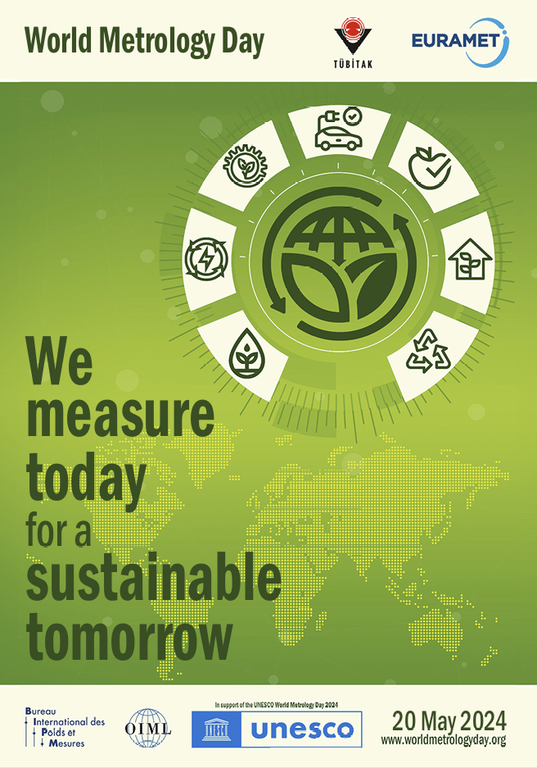
Recognizing the importance of measurements for sustainability, in 2024 the theme of World Metrology Day was "We measure today for a sustainable tomorrow".
World Metrology Day 2024 was also the first World Metrology Day to be celebrated after the official proclamation of World Metrology Day by UNESCO. A special Launch Event [5] was organized by UNESCO in partnership with the BIPM and OIML, and was attended by guests from the Permanent Delegations to UNESCO, Embassies of the BIPM and OIML Member States , International Organizations. and members of the metrology community.
Keynote speeches focused on the pivotal role of metrology in advancing global endeavours toward establishing a sustainable economy and environment for future generations, featuring initiatives at both national and regional levels. A short video [6] showcased examples of everyday measurements and illustrating how metrology contributes to the sustainable development goals.
For some of the many other events that took place around the world on the theme of sustainability, see [7]. The official poster, designed by TÜBITAK (Turkey), is shown below:
3. Survey on environmental sustainability (2024)
Ahead of the 2024 World Metrology Day celebrations, the BIML carried out an online "micro-survey" on environmental sustainability, to gather information about the priorities of its members. Rather than carrying out a comprehensive review, the aim was to gather input on a rapid timescale. The survey was open to all CIML Members and Corresponding Member Representatives from 15 February to 15 March 2024.
A total of 48 responses were received, from 33 Member States and 15 Corresponding Members. Of these, 44 of the respondents answered all 5 questions and 4 respondents (from 1 Member State and 3 Corresponding Members) answered part but not all of the survey. The total number of responses considered below for each question are: Q1: 48; Q2: 47; Q3: 47; Q4: 46; and Q5: 44, respectively.
The results, summarized below, underline the global importance of work in this area.
Q1 What priority does your country place on environmental sustainability? (out of 10)
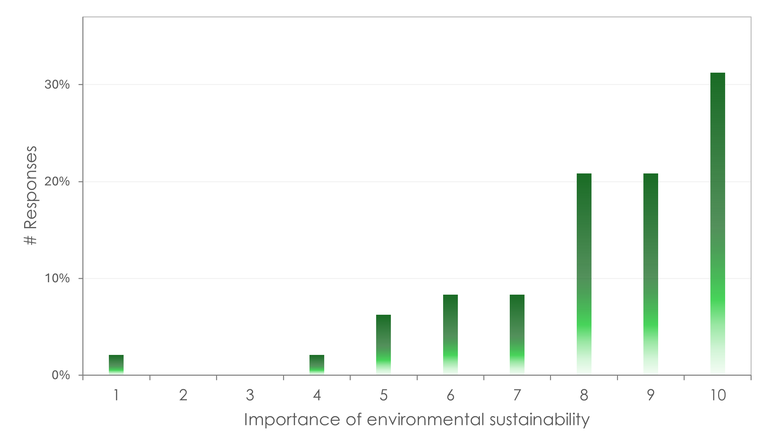
More than 80% of respondents scored the importance of environmental sustainability at 7 or more out of 10. More than 70% of respondents scored the importance at 8, 9, or 10.
The mean score out of 10 was 8.2.
Q2 When it comes to technical regulations and documentary standards concerning environmental sustainability, does your country mainly use national or international standards?
respondents were asked to select the most appropriate option amongst the following:
- Do not know
- Mainly national
- 75% national, 25% international
- 50% national, 50% international
- 25% national, 75% international
- Mainly international
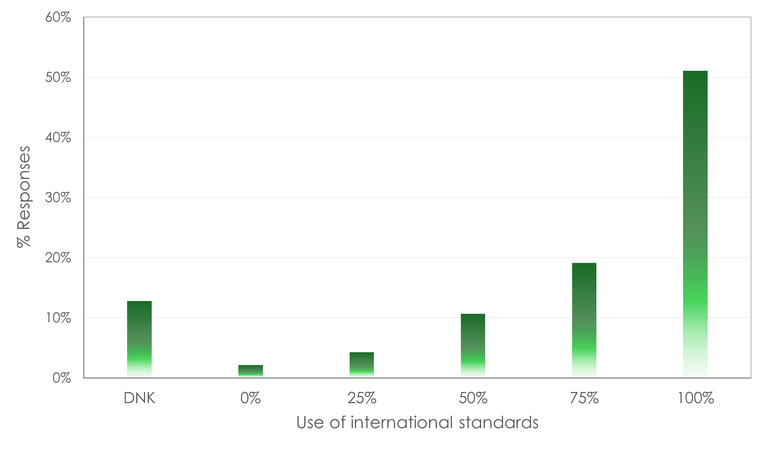
The results showed very significant use of international standards in the technical regulations and documentary standards concerning environmental sustainability. More than 70% of the responses were for answers (e) or (f) above, and more than 50% of the responses were for "mainly international" (f).
If we approximate response (b) "mainly national" as 0% international, and response (f) "mainly international" as 100% international (as illustrated in the chart above), then discounting the "do not know" votes, the mean fraction of international technical regulations and documentary standards was 82%.
Q3 What does your government expect of your country’s National Metrology Institute / Legal Metrology Authority in relation to metrology and environmental sustainability?
Respondents were asked to select all options that applied:
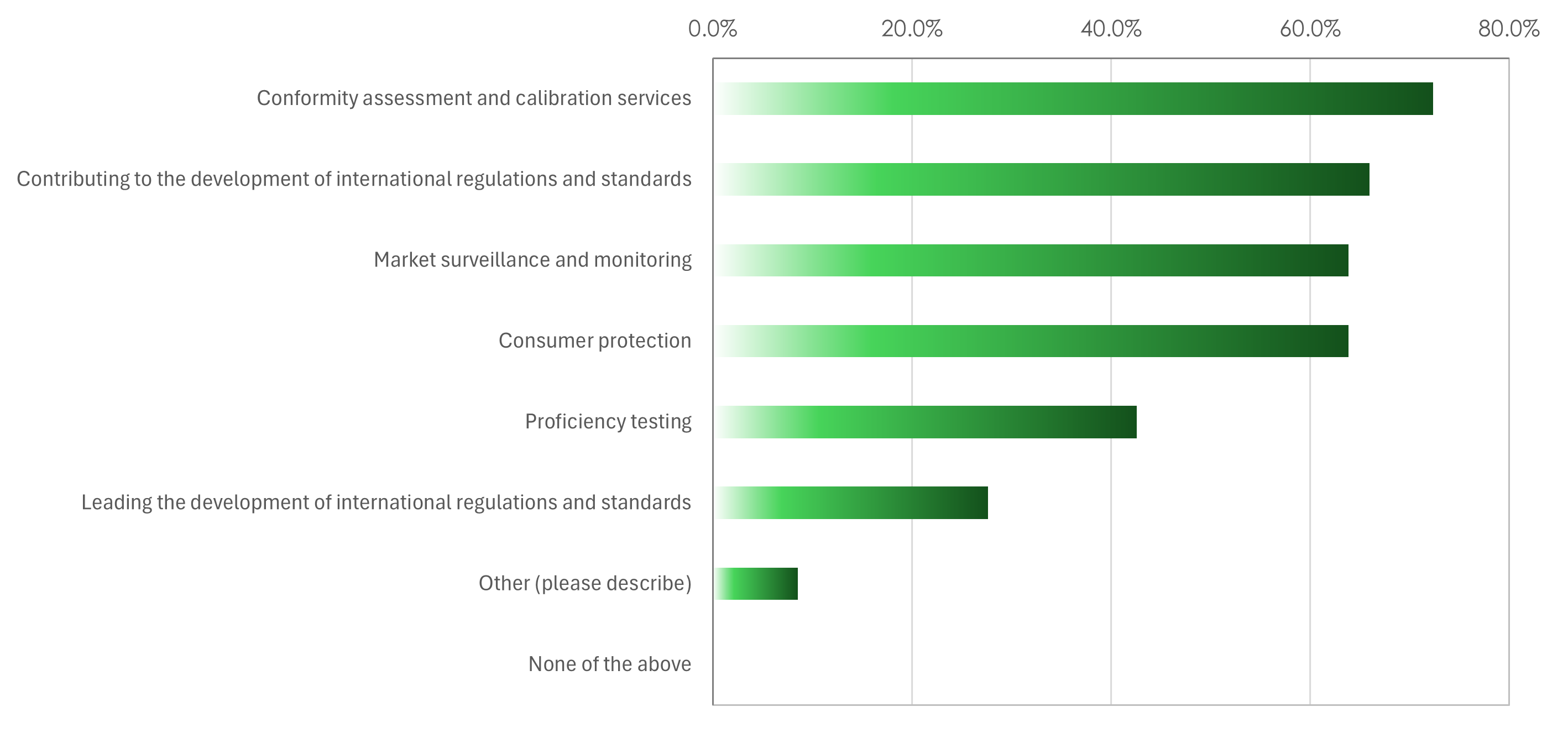
More than 60% of respondents indicated that their governments are expecting their scientific or legal metrology authority to be active in the following key areas of leagl metrology:
- the development of international technical regulations and documentary standards
- consumer protection
- market surveillance and monitoring, and
- conformity assessment and calibration services.
More than 72% of respondents selected "conformity asessment and calibration services".
None of the 47 respondents selected "None of the above".
The "Other" answers specified were:
- Metrological traceability
- Leading the development of national technical regulations and documentary standards
- Keeping stakeholders informed about legislative requirements.
Q4 What are your government’s expectations of the International Organization of Legal Metrology (OIML) in relation to metrology and environmental sustainability?
Respondents were asked to select all options that applied:
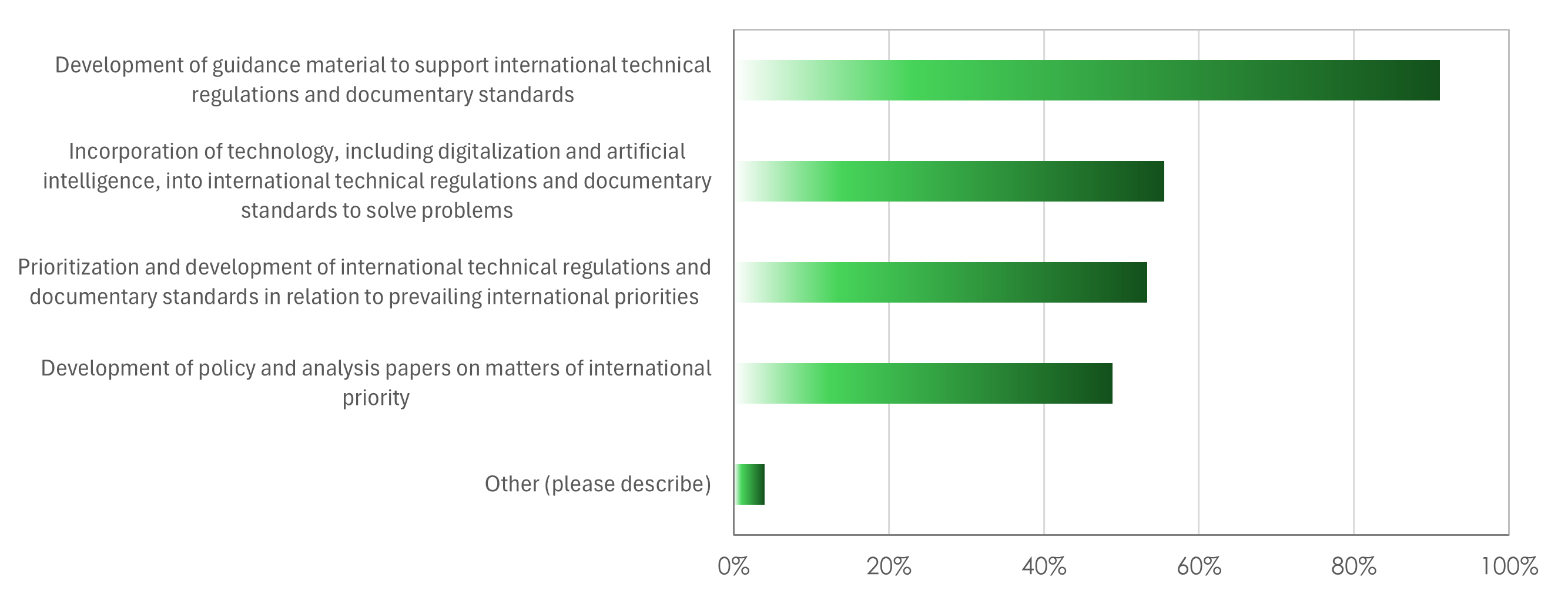
A strong majority (91%) of the 45 respondents indicated that their government expected the OIML to help develop guidance materials in support of international technical regulations and documentary standards in the field of environmental sustainability.
More than 50% of respondents also indicated that their governments expected the OIML to assist in:
- Prioritization and development of international technical regulations and documentary standards in relation to prevailing international priorities
- Incorporation of technology, including digitalization and artificial intelligence, into international technical regulations and documentary standards to solve problems.
Just under 50% of respondents indicated that their governments expected the OIML also to assist with:
- Development of policy and analysis papers on matters of international priority.
Q5 Does your country’s National Metrology Institute / Legal Metrology Authority currently provide measurement services, both regulated and unregulated, to other entities to support environmental sustainability?
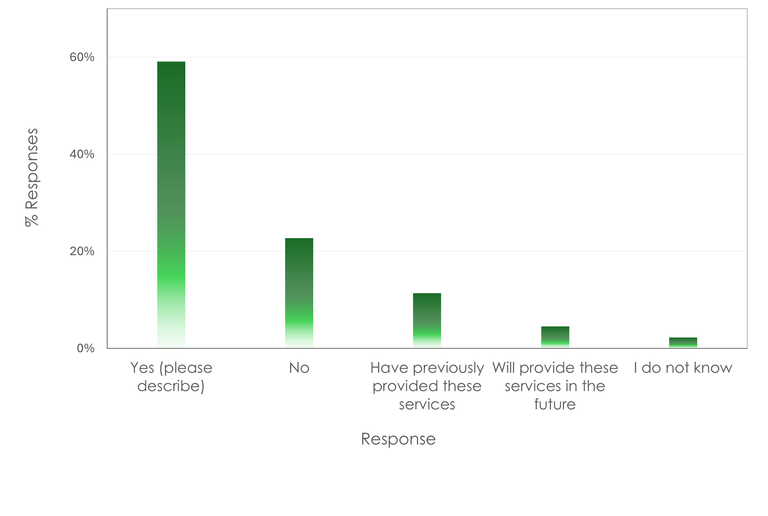
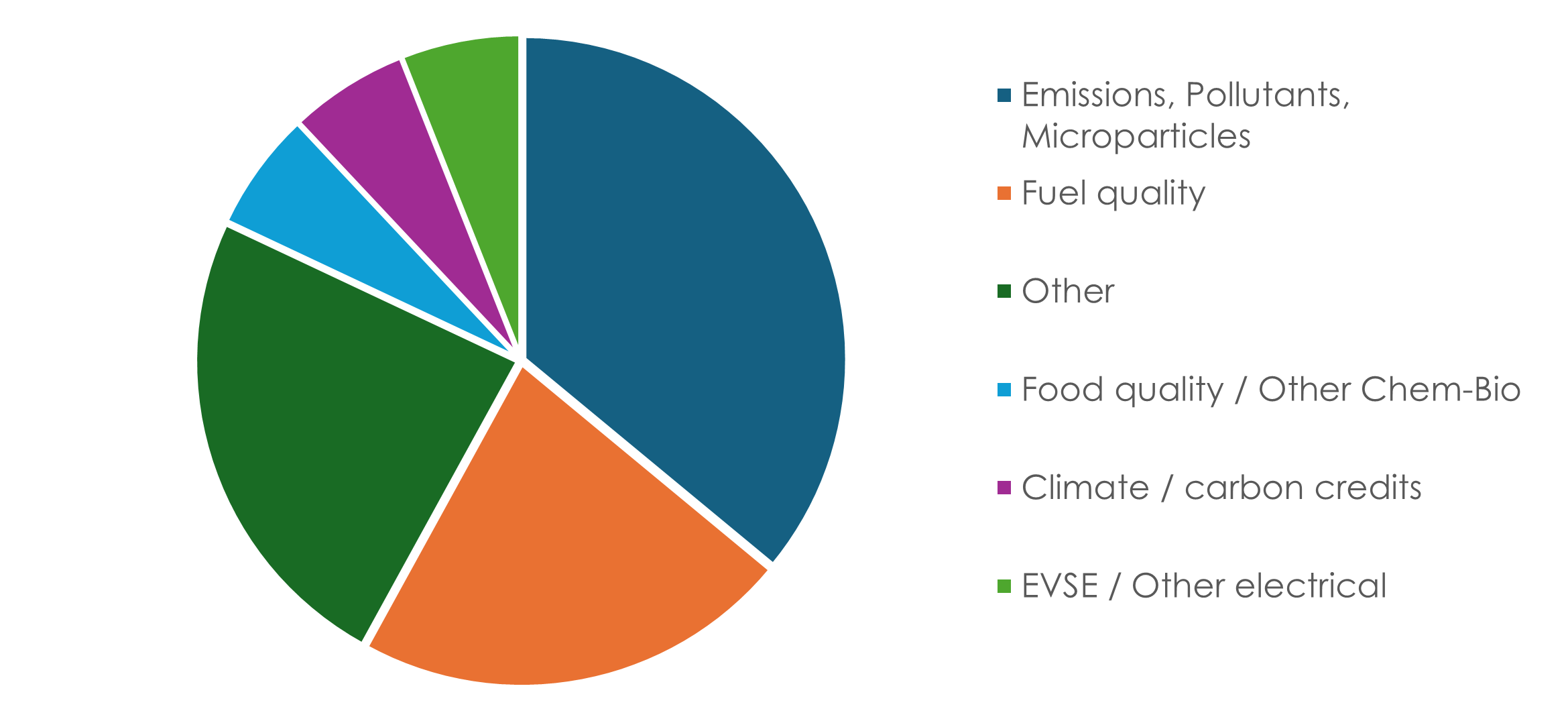
Of the 12 out of 44 respondents who specified their current services, the main areas of activity are indicated below:
4. Progress since Resolution CIML/2024/37
In 2024 the CIML passed the following Resolution:
Resolution no. CIML/2024/37
The Committee,
Recognising the importance of issues in the area of climate change to society, and to the activities of the OIML,
Considering that a number of the OIML’s current activities and technical work projects are aimed at better regulation and cooperation in the field of climate change in legal metrology activities,
Requests the BIML to complete the procedures necessary for the OIML to become an “accepted observer” in the United Nations Framework Convention on Climate Change (UNFCCC),
Requests the BIML to continue to engage with other stakeholders in the field of climate change, and
Encourages its Members to promote the use of legal metrology as an important tool in climate change mitigation and in the energy transition.
In January 2025, the BIML submitted an application to become an "admitted observer" of the UNFCCC [8]. While this application is still pending, the OIML has already engaged with the 29th and 30th UN Conferences of the Parties" (COPs), to promote the importance of legal metrology. The OIML's activities at these events are described in [8].
5. The OIML's publications and technical work and the SDGs
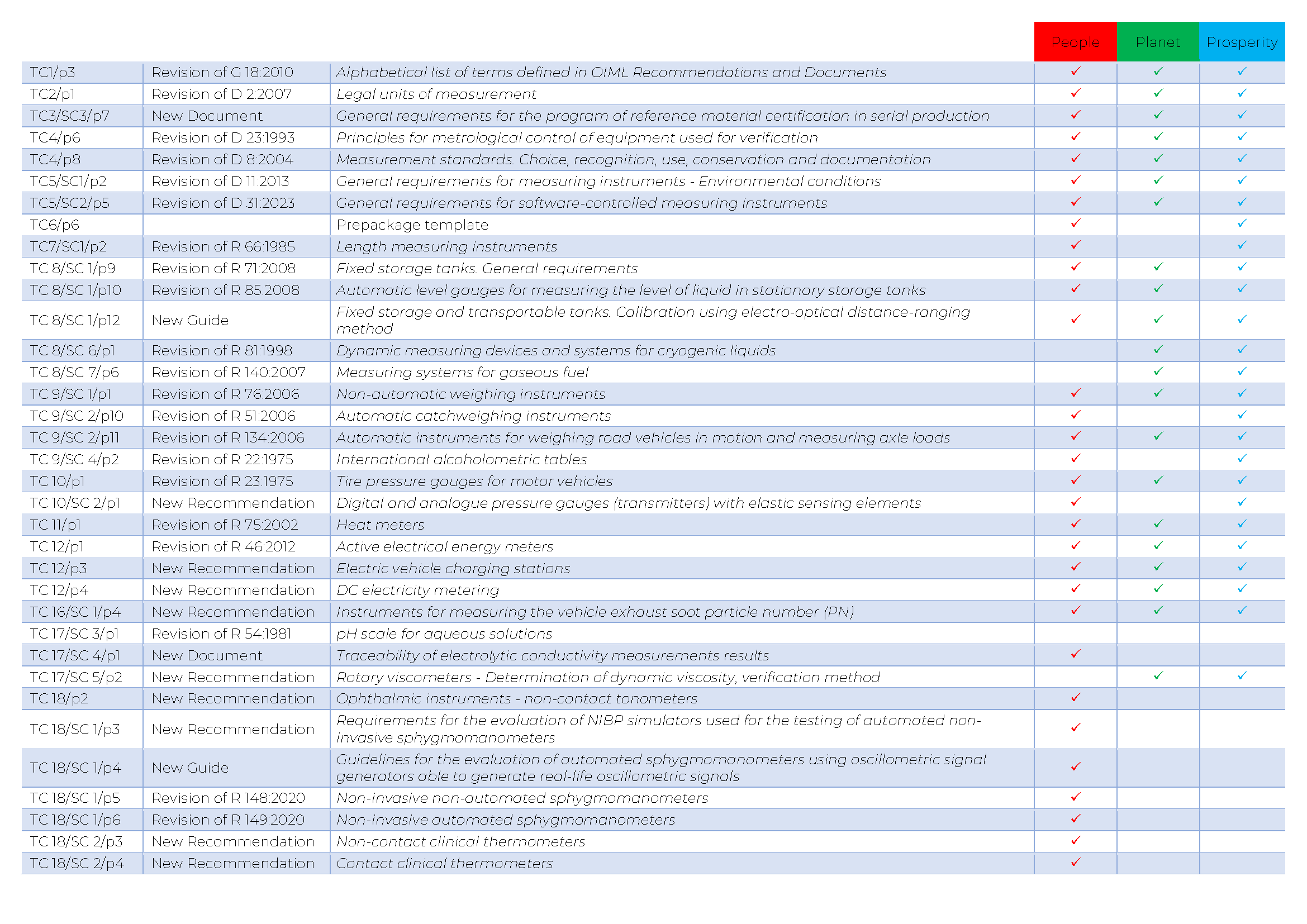
The SDGs are often categorized into the so-called “3 Ps”: People, Planet and Prosperity.
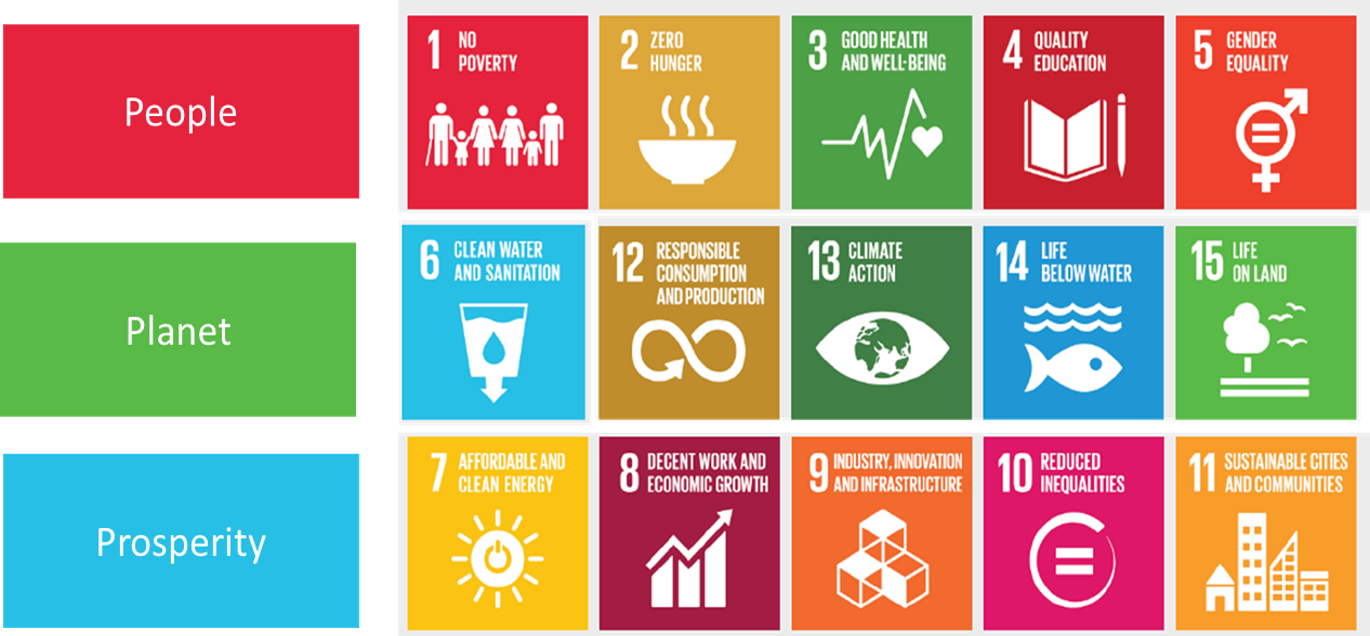
The OIML is one of UNIDO’s partners in developing the Quality Infrastructure for Sustainable Development (QI4SD) Index [4]. In this index, each country has a score representing the state of QI in the People, Planet and Prosperity pillars, using data relating to social, environmental and economic issues respectively. In this section we explore the relevance of the OIML’s technical work in these areas. The mapping of OIML project work to the 3 Ps is presented below and will be included in the 2026 edition of the QI4SD Index; details for the OIML publications will be included at a later date.
An analysis shows that 21 (60%) of the 35 current projects are related to the Planet perspective, which demonstrates the increasing importance of environmental issues to the legal metrology community.
- R 82:2006 Gas chromatographic systems for measuring the pollution from pesticides and other toxic substances
- R 83:2006 Gas chromatograph/mass spectrometer systems for the analysis of organic pollutants in water
- R 99:2008(en) Instruments for measuring vehicle exhaust emissions
- R 112:1994 High performance liquid chromatographs for measurement of pesticides and other toxic substances
- R 113:1994 Portable gas chromatographs for field measurements of hazardous chemical pollutants
- R 116:2006 Inductively coupled plasma atomic emission spectrometers for the measurement of metal pollutants in water
- R 123:1997 Portable and transportable X-ray fluorescence spectrometers for field measurement of hazardous elemental pollutants
- R 143:2009 Instruments for the continuous measurement of SO2 in stationary source emissions
- R 144:2013 Instruments for the continuous measurement of CO and NOx in stationary source emissions
Some Recommendations concern an instrument used in a field such as the measurement of hydrocarbons, for example, in which their main objective is the correct measurement of the quantity of a product. However, these measurements could have serious environmental effects if not conducted properly, or if leakages occurred, which would be detected by the measuring instruments regulated according the relevant OIML Recommendations. They are thus also very relevant to the environment.
In the replies to Q4 of the BIML’s 2024 micro-survey, 91 % of respondents indicated that they expected the OIML to develop guidance materials to support them in the field of environmental sustainability. Future options for providing this support are still under consideration, but the approach that was adopted for Electric Vehicle Supply Equipment (EVSE) might provide an example of such guidance. In 2021, several Member States noted that worldwide developments in the previously unregulated area of electric vehicle (EV) charging were proceeding rapidly, leading to diverging initiatives by individual economies to develop national or regional metrology regulation for EV charging stations. Both legislators and manufacturers would benefit from international harmonization to improve clarity on these devices. The risk of being overtaken by the needs of the market and of legislators showed that there was a need for OIML guidance, so a new Project Group was established by a CIML resolution (CIML/2021/24) to develop an OIML Guide on EVSE as quickly as possible. Very concentrated work by a small group, with rapid turnaround of many drafts enabled the publication of OIML G 23 within one year. Work is now ongoing to convert this Guide into a full OIML Recommendation. The same approach could be used to develop guidance material when concerns in the area of sustainability and the environment have been identified if they are not covered by existing OIML Recommendations.
It can be seen that OIML Recommendations cover a large number of categories of measuring instruments, and these may be covered by regulations under the responsibility of different government departments, ministries, or agencies. If a regulatory system is going to address environmental concerns in an effective, systematic and harmonized way, it is essential that these different bodies are well coordinated. OIML D 1:2020 /National metrology systems – Developing the institutional and legislative framework/ provides guidance on the importance of involving all governmental bodies responsible for different aspects of metrology in order to establish a metrology system as an essential element of modern national quality infrastructure."
6. Conclusions
Legal metrology is no longer just about fair trade and consumer protection; it is the metric by which we measure our planet’s survival. Existing mechanisms for the development of OIML publications can be used to ensure that harmonized legal metrology requirements remain relevant to global regulatory needs. When the CIML meets in October 2026 and assesses its priorities for the coming years, ensuring the reliability of measurements related to climate change, and international harmonization of legal metrology related to emerging technologies, will no doubt remain high on the agenda.
References
[1] UN 2030 Agenda for Sustainable Development: https://sdgs.un.org/2030agenda
[2] UN Sustainable Development Goals (SDGs): https://sdgs.un.org/goals
[3] Global SDG Indicator Framework: https://unstats.un.org/sdgs
[4] UNIDO QI4SD Index: https://hub.unido.org/qi4sd/?year=2024
[5] World Metrology Day Launch Event at the UNESCO headquarters. See https://www.unesco.org/en/articles/world-metrology-day-launch-event; https://www.bipm.org/en/-/unesco-wmd-2024-event
[6] BIPM World Metrology Day 2024 video "Metrology in daily life", available on YouTube: https://www.youtube.com/watch?v=_r7cbepqSf0
[7] Events around the world celebrating World Metrology Day 2024: https://2024.worldmetrologyday.org/events.html
[8] I. Dunmill, OIML participation in COP29, COP30, and the UNFCCC, 2026 OIML Bulletin LXVII(2) 202602XX