OIML BULLETIN - 2026 - VOLUME LXVII - NUMBER 1
r e p o r t
Report by the BIML Director
– BIML matters and activities
Anthony Donnellan 
BIML 
Citation: A. Donnellan 2026 OIML Bulletin LXVII(1) 20260105
Introduction
The BIML has been very busy during the brief period since the 59th CIML Meeting in late October 2024. In this auspicious year marking both the 70th anniversary of the OIML and the 150th anniversary of the signing of the Metre Convention, we are focused on looking to the future of the Organization as well as reflecting on the past. We have participated in a multitude of anniversary events, engaged with social media, and contributed to anniversary publications.

As with every Conference year, a significant project for the BIML is the preparation of the draft budget for the OIML for the next financial period. I am pleased to report that, through careful financial management and planning, the Organization is able to present a draft budget with no increase to the Base Contributory Share for Members, and therefore no increase to Member State contributions. In this report, I will also concentrate on a number of the transformative changes occurring within the BIML to drive the Organization forward.
Digital transformation
The future of the Organization must be digitally enabled and digitally integrated.
Continuing its work from 2024, the BIML has been pursuing transformation initiatives to orientate itself towards a digitally-focused future. It has also been exploring options for future-focused product and service delivery, with a “think digital first” approach to the services, offerings, and products that the BIML provides.
 The importance of these initiatives has been underlined by the reprofiling and recrafting of a position within the BIML to focus on digital services and support the work of the OIML’s Digitalization Task Group (DTG). It is in this context that we are delighted to welcome Dr Janet R. Miles to the BIML. Janet joins us from the International Bureau of Weights and Measures (BIPM), with significant experience of both metrology and digitalization.
In all our projects to improve the “digital-readiness” of the Organization’s products and services, we
aim to increase the value and usability of the OIML’s data through applying the FAIR Principles (i.e.,that data and metadata be Findable, Accessible, Interoperable, and Reusable).
Work also continues in close coordination with our International Organization (IO) counterparts to explore the development of “intelligent” standards to meet the needs of our Members. This is an iterative and evolving process, with continued coordination and cooperation required. I am delighted that the BIML is taking a proactive, leadership role in this regard.
Representing the interests of legal metrology internationally
In support of the OIML’s mission to promote legal metrology, the BIML continues to cultivate cooperative relationships with a wide range of international and intergovernmental organizations. It also seeks opportunities to broaden its spectrum of engagement by developing relationships with new organizations and stakeholders.
From a standardization and conformity assessment perspective, the BIML has been working closely with the International Accreditation Forum (IAF), International Electrotechnical Commission (IEC), International Laboratory Accreditation Cooperation (ILAC), and International Organization for Standardization (ISO). With a focus on the future, the BIML looks forward to working in a constructive and engaging manner with Global Accreditation Cooperation.
From an international trade and harmonization of international technical requirements perspective, the BIML continues to work closely with the World Trade Organization (WTO) Technical Barriers to Trade (TBT) Committee. We are particularly looking forward to contributing to the TBT thematic session on metrology later this year.
We have also engaged with the Testing, Inspection and Certification (TIC) Council, the International Standard Serial Number (ISSN) International Centre, and the International Organization of Vine and Wine (OIV). These latter two being intergovernmental organizations, they allowed a valuable exchange of best practices between the respective secretariats based in France.
The BIML has also continued to provide support to, and participated in, the organizing committees of the International Metrology Congress (CIM2025) and the upcoming International Conference of Weighing (ICW2026).
The BIML continues to provide diplomatic representation and engagement for the OIML with many diplomatic missions represented in Paris, and elsewhere, to advance understanding of, engagement with, and importantly, membership of the OIML. We look forward to more bilateral visits and engagements between the BIML and diplomatic missions, existing and new.
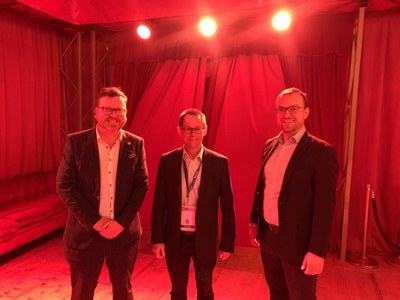
A relaxed moment with Martin Milton and Sascha Eichstädt, celebrating the successful CIM2025
Concerning COP29, the BIML provided support for the CIML President’s participation in the event, as well as a number of other sessions, to advance the interests of the Organization, and to showcase the benefits of legal metrology, consistent with the 2024 CIML Resolution.
Furthermore, the BIML continues to cooperate and engage proactively with our partners - including the International Atomic Energy Agency (IAEA), International Network on Quality Infrastructure (INetQI), Organisation for Economic Co-operation and Development (OECD), United Nations Economic Commission for Europe (UNECE), and United Nations Industrial Development Organization (UNIDO) - to advance capacity building, training, and knowledge transfer opportunities to benefit the diverse range of economies engaged with the OIML, including developing and least developed economies.
Lastly, this year being an anniversary year, the BIML has been supporting the announcements, activities, and events celebrating the 150th anniversary of the signing of the Metre Convention, and therefore the BIPM. In this special year, we have been celebrating the significance to the OIML of the signing of the Metre Convention in 1875. In the OIML’s 70th year, it is clear that the need for international coordination of the legislative and regulatory aspects of legal metrology – as recognized almost 100 years ago – continues to grow.
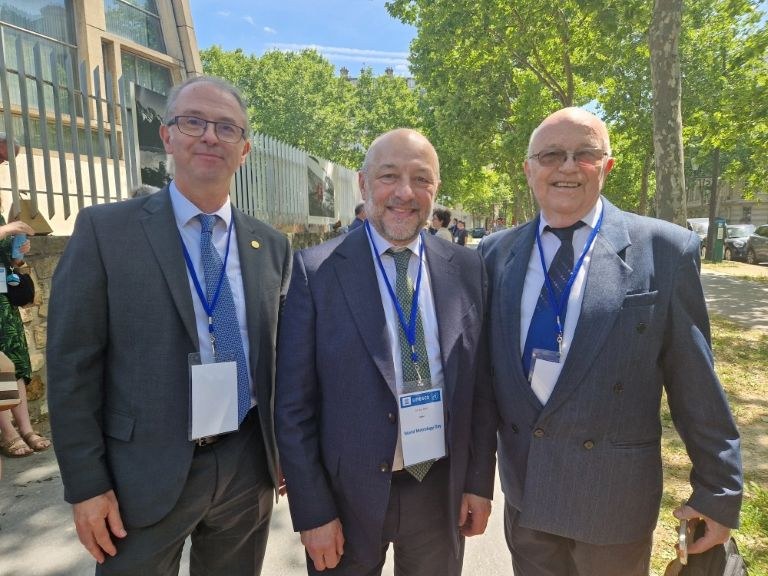
Assistant Directors Paul Dixon and Ian Dunmill pictured with former Assistant Director Attila Szilvassy outside the UNESCO Headquarters during a break on World Metrology Day 2025
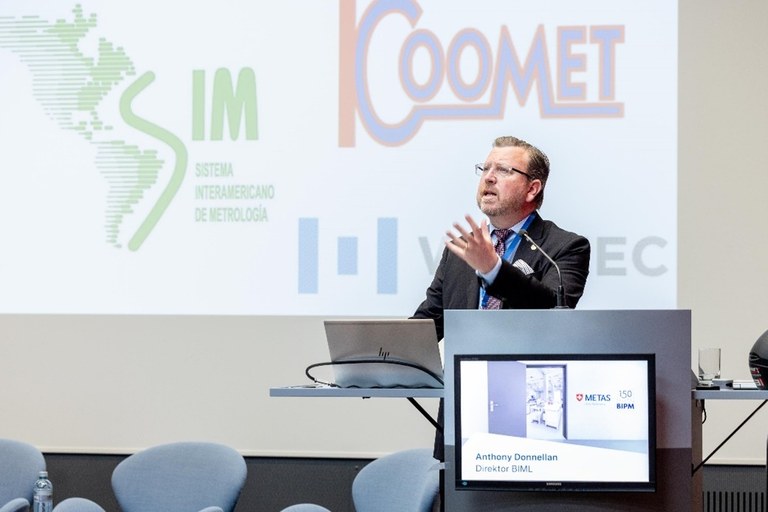
Speaking at a METAS seminar celebrating the 150th anniversary of the Metre Convention
Review of the OIML technical work
As mentioned in my introduction, this short reporting period has continued to be focused on the transformation of the Organization for the future, and it is in this context that we have conducted a comprehensive review of the progress and status of OIML technical projects. The analysis of the data from this review has enabled us to develop proposals which have been endorsed by the CIML President, First Vice-President, Second Vice-President, and Presidential Council. These proposals will be further discussed as part of the 60th CIML Meeting and 17th Conference.
OIML technical publications are developed collaboratively by National Metrology Institutes, Legal Metrology Authorities and industry experts, and their objectives include promoting fairness in trade by ensuring that measures are accurate, increasing consumer confidence in everyday transactions, and reducing disputes between buyers and sellers due to measurement errors. Moreover, OIML technical publications enhance public trust, and support economic growth, by establishing a global framework for accurate and reliable measurements, reinforcing the critical link between accurate legal metrology and public welfare.
I am pleased to report that, following the review of the progress of technical publication development within the Organization, the BIML will be holding a training course for conveners in September 2025. This training will empower and enhance the work of OIML technical project conveners, and the opportunity will be seized to develop e-Learning training products, thereby maximizing the benefit of both the financial and time investment of the Organization.
Governance, finance, and office holder support
The BIML provides support for the International Conference on Legal Metrology, the International Committee of Legal Metrology, the Presidential Council and its various meetings throughout the year, the Countries and Economies with Emerging Metrology Systems Advisory Group (CEEMS AG), the DTG, the OIML Certification System (OIML-CS), and the Regional Legal Metrology Organizations Round Table (RLMO RT).
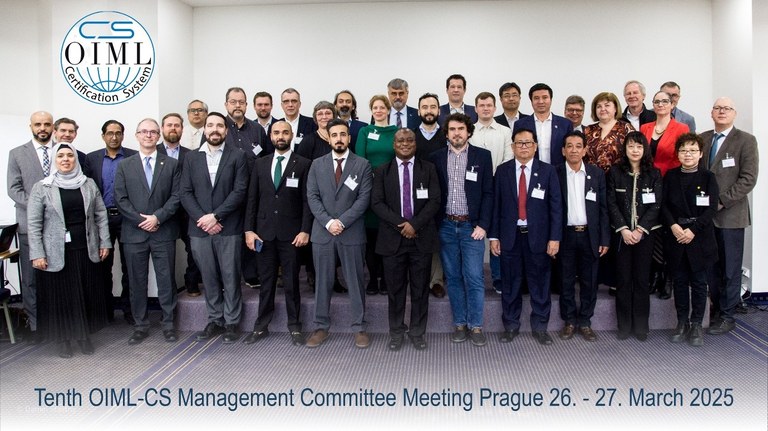
As usual, the BIML has provided advice, continuity of operations, support services, and stability for the Organization as it transforms its operations.
Financially, the Organization remains in a good position, with no need to access the OIML Designated Operating Reserve during this reporting period. Furthermore, multiple rounds of budget presentations and preparations have been undertaken during this period with the various organs of the Organization to develop a future-focused budget for the OIML with no increase to OIML Member State contributions.
Looking back and to the future
In this historical anniversary year for metrology, it is important to reflect on the many achievements since the signing of Metre Convention in 1875 and the establishment of the OIML in 1955. However, the momentum must continue.

There are many opportunities and challenges for metrology now and into the future. International Organizations have a critical role to play regarding consensus building, fairness, and for transformation. Engagement with technology and the integration of Artificial Intelligence in design, processes, and for developing solutions, is important, as is maintaining the integrity, impartiality, and credibility of international systems, frameworks and organizations.
From high-level science, to providing a legal metrology system and framework to protect the most vulnerable individuals and consumers in society, “Measurements for all times, for all people” is as pertinent today as it was in 1875.