OIML BULLETIN - 2026 - VOLUME LXVII - NUMBER 4
f o c u s p a p e r
Mapping the semantic landscape of the international quality infrastructure
Findings from a workshop of JSI signatory organizations
Peter Blattner  1, Stuart Chalk 2, Michael Chrubasik 3, Frank Härtig 4, Matti Heikkurinen 5, Mercè Ferrés Hernandez 6, Daniel Hutzschenreuter 4, Alex Knaak 4, Luca Mari 7, Janet R. Miles 8, Cristhian Paredes 9
1. METAS  , Switzerland, representing the International Commission on Illumination (CIE)
2. University of North Florida , US, representing the International Union of Pure and Applied Chemistry (IUPAC)
3. National Physical Laboratory (NPL) , UK
4. Physikalisch-Technische Bundesanstalt (PTB) , Germany, representing the International Measurement Confederation (IMEKO)
5. CODATA Headquarters??
6. International Organization for Standardization (ISO)
7. Cattaneo University , Italy, representing the Joint Committee for Guides in Metrology (JCGM)
8. International Bureau of Legal Metrology (BIML) , representing OIML
9. International Bureau of Weights and Measures (BIPM)
Citation: P. Blattner et al. 2026 OIML Bulletin LXVII(4) 202604xxpb
Abstract
The digital transformation of the international Quality Infrastructure (QI) depends on the machine-actionability of the terminological resources that underpin it. While the SI Digital Framework provides an emerging anchor for the digital representation of units, the vocabulary layer above it – including the SI Brochure, VIM, VIML, ISO 80000 series, IEC IEV, CIE ILV, etc. – remains largely a set of independently governed, document-centric publications. This report describes a structured two-day workshop convened among signatory organizations of the Joint Statement of Intent (JSI) on the digital transformation in the international scientific and quality infrastructure. Participatory relationship mapping using a modal taxonomy, structured FAIR self-assessment derived from the ten rules of Cox et al. The value propositions of FAIR vocabularies were also discussed and considered in terms of the effort involved in developing a full ontology.
1. Introduction
The international Quality Infrastructure (QI) rests on a shared conceptual foundation. When a calibration certificate reports a quantity, when a standard specifies a tolerance, when a regulator evaluates a conformity declaration, the meaning of the terms involved is assumed to be common across jurisdictions, sectors and languages. That assumption is maintained by terminological resources – vocabularies, thesauri, glossaries – developed and governed by distinct international organizations over decades.
In the past, these resources were utilized by experts in the field through reading and interpreting them. The digital transformation of the QI changes the interlocutor. Terms are increasingly "consumed" by software: by pipelines that must align two datasets, by regulatory systems that must verify a declaration, by retrieval systems, and by generative models that produce text about measurement without principled access to authoritative definitions.
Resolution 2 of the 27th CGPM (2022) [2] states the requirement. Recognizing that maintaining confidence in the global comparability of measurements will require "robust, unambiguous, and machine-actionable representations of measurement units, values and uncertainties", the Resolution encourages the CIPM to develop and promote an SI Digital Framework, and explicitly calls for "the adoption of the FAIR principles (Findable, Accessible, Interoperable, and Reusable) for digital metrological data and metadata" [1]. It further invites all organizations with an interest in the Quality Infrastructure – spanning metrology, standardization, accreditation, conformity assessment and market surveillance – to join the collaborative venture.
The Resolution is explicit about units, but does not explicitly mention the vocabularies defining the concepts to which those units apply. This connection is nevertheless inherent in the FAIR principles themselves: interoperability requires the use of formal, shared knowledge representations and vocabularies that themselves follow FAIR principles [2] as it is not achieved by unit identifiers alone. A machine-actionable representation of the metre is therefore of limited value if the concept of the measurand remains defined only in human-readable prose. Semantic interoperability requires not only the exchange of data, but a shared and unambiguous understanding of their meaning. Making domain vocabularies accessible to both humans and machines is consequently an essential part of making Quality Infrastructure data interoperable [3].
This report describes a workshop convened to establish where the QI vocabulary landscape currently stands. It was deliberately diagnostic rather than programmatic. Participants were told at the outset what was expected – to map relationships, gaps and overlaps; to assess FAIR maturity and agree a small number of reachable improvements; to build a shared understanding of what machine-readable vocabularies make possible. Boundaries were set to exclude discussions on merging any vocabulary, agreeing a unified ontology, resolving long-standing definitional conflicts between standards bodies, or committing any organization to resources or governance changes.
2. Institutional context: the Joint Statement of Intent
The Joint Statement of Intent provides a platform for signatory organizations to indicate their support, in a manner appropriate to each organization, for the development, implementation and promotion of the SI Digital Framework as part of a wider digital transformation of the international scientific and quality infrastructure [3]. The JSI forms part of an ongoing initiative of the International Committee for Weights and Measures (CIPM) and its Forum on Metrology and Digitalization (FORUM-MD), directed to promote digitalization transformation of metrology and the QI in general. The BIPM is a signatory alongside the International Organization of Legal Metrology (OIML), the International Commission on Illumination (CIE), the Committee on Data of the International Science Council (CODATA), the International Electrotechnical Commission (IEC), Global Accreditation Cooperation Incorporated (GLOBA ACI), the International Measurement Confederation (IMEKO), the International Science Council (ISC), the International Organization for Standardization (ISO), the International Union of Pure and Applied Chemistry (IUPAC), and NCSL International (NCSLI).
The JSI roundtable convenes these organizations periodically to discuss and report progresses in respect to digitalization efforts. The March 2026 meeting was the first devoted specifically to terminological and semantic.
3. The vocabularies of the QI network
Nine resources were presented in structured pitches on the first day, each covering scope, size, official languages, main users and regulatory adoption, governing body, revision cycle, licensing and current digital access. They differ substantially along every one of these axes, and this heterogeneity is itself a finding: the network does not consist of comparable objects.
SI Brochure (BIPM/CIPM/CCU)
The defining document of the International System of Units, establishing the seven defining constants, base and derived units, prefixes and rules of use. Its terminological content is normative for essentially every other resource in the network. Its digital counterpart, the SI Reference Point in the SI Digital Framework, provides resolvable identifiers for units and defining constants [4].
VIM – International Vocabulary of Metrology (JCGM)
JCGM 200 (or "VIM"), developed by JCGM Working Group 2, defines the general concepts of metrology: measurand, measurement uncertainty, metrological traceability, calibration, reference materials [5]. Its definitions are incorporated by reference across accreditation, conformity assessment and laboratory practice worldwide. At the time of the workshop, a fourth edition of the VIM was in voting draft .
VIML – International Vocabulary of Terms in Legal Metrology (OIML)
OIML V 1 (or "VIML") extends metrological terminology into the legal and regulatory domain: type approval, verification, legal control, market surveillance. It stands in a defined relationship to the VIM while serving a distinct community of national legal metrology authorities.
ISO 80000 series (ISO)
A multi-part standard covering quantities and units across mathematics, physics, mechanics, thermodynamics and electromagnetism, providing the quantity-kind layer that complements the unit layer of the SI Brochure, and jointly maintained with IEC for the electrotechnical parts.
IEV – Electropedia (IEC)
The International Electrotechnical Vocabulary, published online as Electropedia, is among the largest technical terminological resources in existence, spanning tens of thousands of multilingual terms and heavily cross-referenced from IEC standards and, as the workshop established, from resources maintained by other organizations.
ILV – International Lighting Vocabulary (CIE)
CIE S 017, published online as the e-ILV, defines the terminology of light and lighting: photometric and radiometric quantities, colorimetry, vision. Many entries carry historical numbering from earlier IEC 60050-845 and CIE S 017 editions, reflecting a long-standing joint relationship with the IEV.
Green Book (IUPAC)
Quantities, Units and Symbols in Physical Chemistry, the authoritative reference for notation and terminology in physical chemistry. Several participants argued it should hold explicitly normative status for chemical quantities across the network – a status it currently holds by convention rather than declaration.
Online Browsing Platform – OBP (ISO)
Aggregates terms and definitions extracted from published ISO standards into a single searchable interface across a very large heterogeneous corpus. It functions as a terminological aggregator rather than a governed vocabulary in its own right, which raises distinct questions about definitional authority.
Hazard Information Profiles (UNDRR-ISC)
A comparatively recent resource providing structured descriptions of hazard types across geophysical, hydrometeorological, biological, technological and societal domains. Unlike the others, it was designed with digital use in view from the outset, and thus offers a useful contrast case.
[INCLUDE EACH OF THESE IN THE REFERENCES
4. Method
Three tools were prepared in advance.
4.1 Relationship mapping tool
A taxonomy distinguished formal links (normative, informative), semantic relations (technically harmonized, partially overlapping, in conflict) and an open other category. Each relationship carried a modal qualifier – is, should be, could be – allowing participants to separate the current state from a desired or possible one, and a direction (A→B, B→A, A↔B). A browser-based tool recorded relationships as structured records, rendered them as a directed graph with type-coded edges and qualifier-coded line styles, and exported to JSON for aggregation. Groups worked either on flipchart or with the tool.
4.2 FAIR self-assessment instruments
Two complementary checklists were implemented as interactive grids. The first operationalized the 24 automated checks of FOOPS! [6] as self-assessment statements across the four FAIR dimensions. The second implemented the ten rules of Cox et al. [7], decomposed into 20 checks and extended with an explicit Governance dimension covering scope definition, custodianship, change process and prior-art survey. Both used a three-state response – yes, don't know, not yet – with only affirmative responses scoring, so that uncertainty was recorded rather than resolved by optimistic default.
It was intended that the groups include at least one representative of the organization responsible for the vocabulary under assessment and at least one participant with FAIR expertise. In practice only the Cox et al. evaluation was used and one group had no representative for the vocabulary under assessment.
4.3 Worked formalization
The path from vocabulary to ontology was illustrated using the VIM definition of measurement, developed through the semiotic triangle and three explicit conditions culminating in an encoding in the Web Ontology Language (OWL 2) and a demonstration of inference. This is described in Section 5.4.
Tthroughout both days, group work alternated with plenary report-back.
5. Findings
5.1 A dense, layered and partly aspirational relationship structure
The exercise was designed to make the complexity of the relationship structure visible rather than to inventory it. The collated results of exercise 4.1, shown in Figure 1, are not a survey of the network, and no quantitative claim is made from them. What they illustrate is the shape of the problem, as – in addition to the fact that these particular vocabularies are not in conflict – three main features stand out.
5.1.1 Relationships are multilayered
The same pair of vocabularies often shares more than one type of relationship, differing by scope and by aspect. The SI Brochure and the IEV were recorded as both normative and informative. The latter specifically outlines the photobiological quantities of Appendix 3 of the SI Brochure, for example, and their relation to the IEC. The SI Brochure and ISO 80000 were recorded as both normative and partially overlapping to other vocabularies.
5.1.2 Relationships are directional and sometimes circular
The Green Book and the SI Brochure were recorded in the two directions with different modalities: the SI Brochure is normative for the Green Book, while the Green Book should be technically harmonized to the SI Brochure. The IEV and the ILV were recorded as being in a relationship that ought to be mutually normative. Where A is normative for part of B and B for part of A, the dependency graph contains circular relations, in which case if there is a conflict between definitions then an order of precedence cannot be established through hierarchy. Participants noted that ideally a single responsible body per concept would be the clean solution, while acknowledging that this is not achievable in the present institutional landscape and is unlikely to be possible in the future.
5.1.3 A substantial share of relationships do not exist but should
The modal qualifier proved the most informative field in the exercise. Repeatedly, participants recorded relationships that experts regard as substantively appropriate but which are not explicitly declared – neither in machine-readable form, not, in the majority of cases, in any form. IEV ↔ ILV should be mutually normative; VIM → IEV should be normative; the Green Book should be technically harmonized to both the SI Brochure and the IEV. These are not speculative proposals; they describe alignments the community already relies on informally.
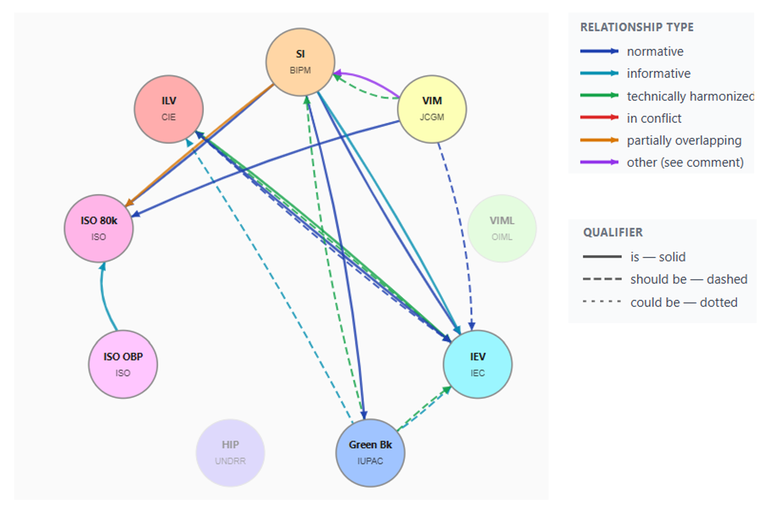
Figure 1. Relationship graph produced during the exercise, rendered from the exported records.
In Figure 1 the vocabularies are represented as nodes (circles); the colour of the edges (lines) encodes the relationship type (normative, informative, technically harmonized, partially overlapping, other) and the line style encodes the modal qualifier (solid = "is", dashed = "should be", dotted = "could be"). Multiple edges between the same pair of nodes indicate relationships holding simultaneously in different respects.
Separately, and most consequentially, it emerged that one organization is preparing to change the identifiers of its terms without awareness that another vocabulary in the room had built substantial reference structures on those identifiers. Neither party had acted incorrectly within its own governance framework. Nothing in current arrangements would have surfaced the conflict before the change was executed. The episode constituted the workshop's clearest empirical argument for policies on persistent identifiers (PIDs), consistent with the general position that persistent identifiers are the cornerstone of any distributed semantic infrastructure [7, 8].
Participants further agreed that mapping of this kind cannot be delegated to information specialists working without domain experts, nor automated from current representations: recognizing that two definitions are in tension requires subject-matter expertise. And they noted that divergent revision cycles cause silent drift; two definitions aligned at one moment can diverge without either party intending it, and with no mechanism in place to detect the divergence.
5.2 Divergence between internal and external FAIR assessment
The most methodologically interesting result was unplanned. Two groups independently assessed the FAIRness of a vocabulary, both groups using the same instrument. The group containing a representative of the responsible organization returned an assessment of approximately "50 % FAIR"; the group assessing externally returned approximately "35 % FAIR".
The result rests on a single paired observation and should not be read as a quantitative estimate of assessor bias. The focus is on the qualitative aspect, which is easy to explain. Insiders possess undocumented knowledge: that a persistence commitment exists though unpublished, that a change process is followed though unwritten, that a definition is understood in a particular way within the committee though the text does not say so. When a checklist item is ambiguous, that knowledge resolves it favourably. An external assessor sees only what is discoverable – which is precisely what a machine sees.
The practical implication is that FAIR self-assessment will be systematically optimistic, for structural rather than motivational reasons. Ideally assessment protocols should therefore pair internal with external assessment, or anchor both against an automated validator.
An argument presented during the FAIR input session merits recording, because it underwrites the applicability of the whole instrument set. ISO 8000-2 defines data as a reinterpretable representation of information in a formalized manner suitable for processing, and a dataset as a logically meaningful grouping of data [12]. A machine-readable vocabulary satisfies both definitions: terms, definitions, relations and provenance metadata constitute a logically grouped, formalized representation of information. If that identification is accepted, the FAIR principles apply to vocabularies directly rather than by analogy, and digital maturity for vocabularies becomes assessable using the same criteria as for data – via the RDA FAIR Data Maturity Model [13], and via the eleven Features of a FAIR Vocabulary derived from it by Xu et al.[14].
The same session emphasized that two questions precede any technical deliberation: scope – what does this vocabulary cover, and explicitly what does it not cover – and governance – who is responsible, and how will it be maintained over time. Governance includes custodianship (a named authority to create, modify and retire terms), maintenance, feedback (agreed processes for reviewing, recording and releasing changes), and change traceability (appropriate implementation and recording of changes with accessible provenance). Without these, the impact and usefulness of technical outputs is likely to be short-lived.
All participating organizations identified specific improvement areas in their own scoring during the exercise.
5.3 Coordination as compensation for incomplete FAIRness
Combining the first two findings produced the workshop's central conclusion:
As long as vocabularies are not fully FAIR, explicit inter-organizational coordination must compensate for what formal interoperability cannot yet provide.
The relationship is reciprocal and, in principle, quantifiable. Where identifiers are not persistent, organizations must inform one another before changing them. Where mappings are not machine-readable, experts must notice divergence by reading. Where relationships ought to hold but are declared nowhere, alignment depends on shared assumption rather than shared structure. Each is a coordination cost incurred because an interoperability property is absent. Improving FAIR maturity is therefore not only a technical objective but a mechanism for reducing the ongoing human coordination burden across the network, a framing participants found more persuasive than compliance-oriented arguments.
5.4 From vocabulary to ontology: three conditions and what resists them
The formalization session was structured around the semiotic triangle: terms in a language, concepts expressed by definitions in a body of knowledge, and entities in the world. The VIM definition of measurement served as the worked example, chosen because it is the central concept of the field and because the difficulties of its formalization are representative rather than exotic.
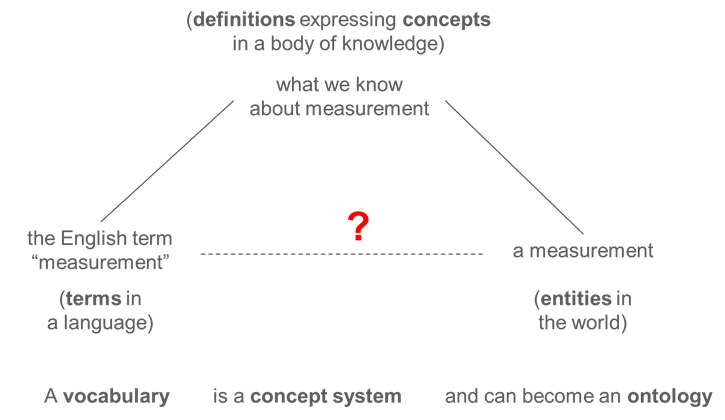
Figure 2. Semiotic triangle: terms in a language, concepts expressed by definitions in a body of knowledge, and entities in the world.
A vocabulary is a concept system, and may become an ontology – a formal, explicit specification of a shared conceptualization [15] – provided the following three conditions hold.
Condition 1:
Definitions must be intensional. ISO 704:2022 [16] defines an intensional definition as one conveying the intension of a concept by stating the immediate superordinate concept and the delimiting characteristics. It also states that intensional definitions are preferable to other types and should be used whenever possible. The VIM definition satisfies this: measurement is a "process of experimentally obtaining one or more quantity values that can reasonably be attributed to a quantity". The superordinate concept – process – establishes a necessary condition; the delimiting characteristics establish sufficiency. An intensional definition therefore does two things at once: it places the concept in a hierarchy, and it sets necessary and sufficient conditions. Both are prerequisites for expressing the concept as an OWL equivalent class rather than merely a subclass.
Condition 2:
The substitution principle must apply. In any definition it must be possible to replace a defined term by its definition without introducing contradiction or circularity. Substituting the VIM definition of quantity – "property of a phenomenon, body, or substance, where the property has a magnitude that can be expressed as a number and a reference" – into the definition of measurement yields a longer but coherent statement. The substitution principle is a necessary condition of structural consistency, and it is testable: a vocabulary that fails it cannot be formalized without first being repaired.
Condition 3:
Residual ambiguity must be identified and removed. This is where the difficulty concentrates. A first formalization pass gives:


The formalization is now complete and supports inference. As a knowledge graph it can be expressed in one of the standard notations (such as Turtle or JSON-LD) of the Resource Description Framework (RDF) – the W3C data model that represents information as subject–predicate–object statements, and the common substrate on which both of the representation languages discussed below are built.
The second formalization has introduced a class, ReasonableJustification, that does not appear in the VIM. Formalization did not merely encode the definition; it required committing to an ontological entity the source vocabulary does not define. This is the general shape of the problem.
Making a definition explicit requires stating what entities exist in the ontology and what relations connect them, and that commitment routinely exceeds what the consensus text authorizes. In standards work, ambiguity is often deliberate – it encodes agreement that a boundary should remain flexible across communities of practice with differing conventions. Resolving it is an editorial and governance decision, not an engineering one, and it cannot be delegated to an ontology engineer working alone. This step also highlights the general challenge posed by digitalization: human language often contains ambiguities which are then interpreted by the reader in context. In a digital transformation, these ambiguities must be eliminated.
To close the session, three open questions were posed:
- Metrology is a complex body of knowledge... Would we be able to develop an ontology at all?
- Metrology is a moving target... Are we ready for one ontology?
- Generative AI is becoming more powerful... Do we still need an ontology?
On the third, two complementary framings were articulated:
- AI for ontology refers to using generative models to assist in constructing, extending and maintaining formal representations, reducing the specialist effort required to formalize a large vocabulary.
- Ontology for AI refers to using structured, authoritative vocabularies to ground and constrain model outputs, so that generated statements can be verified against a definition of known provenance.
Participants noted a possible secondary benefit of the latter: a system whose domain knowledge is carried by an explicit ontology do not require a very large model to perform reliably, with corresponding reductions in computational cost.
This makes the choice of representation language consequential, and the two candidates differ in what they claim rather than merely in how much they can express. The Simple Knowledge Organization System (SKOS) is a W3C Recommendation built on RDF and designed for precisely the kind of resource represented in the room: thesauri, taxonomies and controlled vocabularies [17]. It supplies preferred and alternative labels in multiple languages, definitions and scope notes, hierarchical and associative links between concepts, and mapping properties for aligning one vocabulary with another. What it deliberately does not do is make logical assertions. Recording that one concept is broader than another states an editorial judgement about the concept system; it does not license a reasoner to conclude anything about the entities those concepts denote. OWL makes the opposite trade. Its class axioms are statements in a formal logic and a reasoner may draw conclusions from them – which is what makes the inference in the measurement example possible, and equally what makes the ReasonableJustification commitment unavoidable. In summary, SKOS describes a concept system, OWL asserts a theory about the entities the concepts refer to.</p
[JRM] I WOULDN'T WANT TO IMPLY A CHOICE BETWEEN SKOS AND OWL. WE CAN USE BOTH OF THEM AND DEFINE ADDITIONAL TERMS WHERE NEEDED.
The pragmatic position therefore converged on the hierarchy visible in the wider literature and stated directly in the FAIR input session: SKOS for shared vocabularies, OWL for domain models requiring formal reasoning – complementary, not competing. SKOS is close enough to the structure domain experts already use that vocabularies can be maintained by existing custodians with modest training, and it delivers the interoperability properties most current consumers require. OWL is justified where a concrete reasoning requirement exists, and not otherwise. This mirrors the comparison of semantic expressiveness approaches presented by Hbeich et al. for digital product passports, who observe that ontology-based approaches provide native cross-domain interoperability and automated validation but require careful design, clear governance and maintenance rules, and a specific skill set that benefits from tooling concealing the formal machinery from the user [18].
5.5 Anchoring at scale: the IEC CDD and the SI Reference Point
Among the advanced implementations presented, work connecting the IEC Common Data Dictionary (IEC CDD) to the BIPM SI Reference Point provides the workshop's clearest demonstration that anchoring is achievable at production scale. The motivation was stated as semantic traceability of concepts to a trusted source: 7 SI base units and 22 derived units with special names and symbols give rise, in industrial practice, to more than 2 150 relevant variations, and each of those requires a defensible route back to the SI.
Of 2168 units in the IEC CDD, 2080 (96 %) carry both an internal conversion and a conversion to the SI Reference Point. Sixty-four carry neither; twenty-four carry an internal conversion without an SI Reference Point counterpart. The IEC CDD is published as an online, public, reusable unit repository under IEC 62720 [15]. Applications identified include conversion between SI and non-SI units via API, and automated data interoperation for digital product passports.
The lessons recorded by the moderator were organizational rather than technical: that industry perspective, applied digitalization and metrological knowledge must be present simultaneously and work as a motivated team; that consolidation and quality checking are done by hand while repetitive and error-prone tasks are automated; and that a shared understanding and common terminology of the subject is fundamental to interoperable knowledge exchange. The last of these is precisely the workshop's premise, arrived at independently from implementation experience.
5.6 Value proposition
Making an established vocabulary FAIR can require substantial effort. In addition to the technical conversion into machine-readable representations, it requires decisions on governance, persistent identifiers, licensing, publication, versioning, maintenance and relationships to other vocabularies. The benefits are consequently not always immediate or easily expressed as a conventional return on investment. Participants therefore compiled a working list of value propositions for FAIR vocabularies in the QI context:
- Improved quality and consistency: Formal representation of concepts and their relationships makes inconsistencies, overlaps and gaps easier to identify, both within an organization's vocabulary and between vocabularies maintained by different QI organizations.
- Reduced duplication of implementation effort: A harmonized approach allows organizations to reuse common patterns, tools and infrastructure, learn from each other's experience and, where appropriate, build on shared structures rather than developing solutions independently.
- More systematic governance and maintenance: Explicit governance, versioning and change histories make the evolution of a vocabulary traceable and changes easier to communicate and propagate. This does not necessarily make vocabulary maintenance less demanding, but can reduce ambiguity and downstream coordination effort.
- A semantic foundation for data interoperability: FAIR vocabularies provide stable, machine-actionable references to the meaning of data elements and thereby complement syntactic and technical mechanisms for exchanging QI data.
- Programmatic reuse: Machine-readable vocabularies can be referenced, queried and integrated by software, including search and information-retrieval systems, data-integration and regulatory-compliance tools, literature databases and AI-based applications. This reduces the need to reinterpret and manually curate terminology at every integration point.
- Explicit and assessable harmonization: Formal mappings between vocabularies make both agreements and differences visible. They convert an assumption of shared meaning into explicit statements that can be inspected, maintained and, where suitable metrics exist, evaluated systematically.
- Persistent reference to concepts: Stable identifiers allow vocabulary concepts to be cited unambiguously from datasets, standards, digital certificates, APIs and other digital artefacts. They decouple the identity of a concept from a particular document or representation and provide a stable basis for long-lived digital information.
Point 6 warrants particular emphasis in light of Section 5.1. Relationships that appear as if they ought to hold but are declared nowhere, as well as concept pairs that stand in several relationships simultaneously, are precisely the kinds of issues that an explicit machine-readable mapping layer can expose.
The value proposition should nevertheless not be interpreted as implying that every QI vocabulary should be made fully FAIR irrespective of cost. The investment and the benefits occur at different places and on different timescales: the effort of making a vocabulary FAIR is largely concentrated at the vocabulary provider, whereas benefits accrue repeatedly to vocabulary users, data producers, software developers and other QI organizations. The return therefore becomes more compelling as a vocabulary is reused across more datasets, applications and organizational boundaries.
From this perspective, a FAIR vocabulary can be regarded as shared semantic infrastructure. Its value lies less in replacing a glossary by a technically more sophisticated representation than in avoiding repeated interpretation, mapping and reconciliation wherever that glossary is subsequently used. The case for investment is consequently strongest for authoritative, relatively stable vocabularies that are widely reused, cross organizational boundaries, or provide terminology for machine-actionable QI data. A proportionate and incremental approach to making a vocabulary FAIR may therefore be preferable to treating FAIR as an all-or-nothing objective.
6. Outcomes and agreed actions
Six actions were agreed by the participants.
- Raise awareness within the respective organizations of the importance of persistent identifiers, for both current and version-specific references, consistent with the FAIR principles.
- Review the feasibility of a registration and look-up service for ontologies and vocabularies of the quality infrastructure.
- Develop Turtle templates for QI vocabularies, defining a minimum required structure and a richer metadata profile, building on the examples produced during the workshop.
- Continue the exchange of information on data and information models across organizations, aiming to identify structural similarities and harmonization opportunities.
- Assess the competences available within the group, to establish which more elaborate projects are feasible and who could carry them.
Action 3 is the most immediately tractable. A Turtle template with a defined minimum profile gives each organization a concrete starting point requiring no governance change and no new budget line, and it directly addresses the most frequently failed items in the FAIR assessment.
An online event on the Information Model of Smart Standards is planned. A next JSI roundtable workshop is scheduled for autumn 2026 with proposed topics including the SI Reference Point, the common data directory, interoperability, traceability, and the handling of units without SI representation.
7. Conclusion
The QI vocabulary network proved to be more interdependent than was visible from the perspective of any individual participating organization. Much of this interdependence is currently maintained through human coordination rather than explicit, machine-readable relationships. Participants repeatedly identified relationships that they regarded as substantively valid but that were declared nowhere, and found that the same pair of vocabularies could stand in several relationships simultaneously. In one case, a planned change to an identifier scheme in one organization would have affected another organization's reference structures, without an established mechanism for detecting the dependency in advance.
This diagnostic finding reframes the objective. FAIRness should not be pursued as an end in itself. The practical objective is to replace undocumented dependencies and implicit mutual knowledge, where appropriate, with persistent identifiers, explicit mappings, provenance and machine-actionable relationships. Human coordination will remain necessary, but it should increasingly be supported by structures that make dependencies visible, testable and maintainable.
Formalization provides such structures, but it comes at a cost and should be proportionate to the intended use. The three conditions derived from ISO 704 provide operational criteria for assessing the degree to which terminological relationships can be formalized. The measurement example illustrates both that the VIM satisfies the first two conditions and that satisfying the third would require ontological commitments not made by the source vocabulary itself. This supports the use of SKOS as a pragmatic default for publishing and interlinking QI vocabularies, with stronger OWL semantics introduced where explicit reasoning requirements justify the additional commitments and effort.
CGPM Resolution 2 (2022) established machine-actionable representation of the SI as an important foundation for maintaining trust in measurement in the digital era [1]. The terminological layer above the units is where that trust is either extended into practice or lost.
Extending that trust beyond units requires an equally reliable semantic infrastructure for the quantities, measurands, properties and other concepts used throughout the Quality Infrastructure. The workshop suggests that this need is not primarily for a single harmonized vocabulary, nor for maximal formalization, but for a network of authoritative vocabularies whose concepts can be persistently identified, accessed, related and reused across organizational boundaries.
The resulting direction is therefore incremental rather than all-or-nothing:- make existing vocabularies identifiable and accessible;
- expose their concepts in machine-readable form;
- make important cross-vocabulary relationships explicit;
- establish governance for change; and
- measure coverage and remaining gaps.
Such an approach concentrates effort where interoperability creates demonstrable value while allowing the QI vocabulary network to evolve without requiring participating organizations to surrender their individual terminological responsibilities.
Acknowledgements
The authors thank all participants of the JSI Roundtable Workshop "Vocabularies", and ISO for hosting the meeting at its Central Secretariat in Geneva.
References
[1] General Conference on Weights and Measures (CGPM), “Resolution 2 of the 27th CGPM (2022): On the global digital transformation and the International System of Units,” Bureau International des Poids et Mesures, Sevres, 2024.
|
[2] |
M. D. Wilkinson, M. Dumontier and I. J. Aalbersberg, “The FAIR Guiding Principles for scientific data management and stewardship,” Scientific Data, vol. 3, p. 160018, 2016. |
|
[3] |
S. J. D. Cox, A. N. Gonzalez-Beltran, B. Magagna and M.-C. Marinescu, “Ten simple rules for making a vocabulary FAIR,” PLOS Computational Biology, vol. 17, no. 6, p. e1009041, 2021. |
|
[4] |
Bureau International des Poids et Mesures, “Joint Statement of Intent on the digital transformation in the international scientific and quality infrastructure,” [Online]. Available: https://www.bipm.org/en/liaison/digital-transformation. [Accessed 30 03 2026]. |
|
[5] |
Bureau International des Poids et Mesures, “SI Digital Framework and SI Reference Point,” [Online]. Available: https://si-digital-framework.org/. [Accessed 30 03 2026]. |
|
[6] |
Joint Committee for Guides in Metrology (JCGM), “JCGM 200:2012 - International vocabulary of metrology: Basic and general concepts and associated terms (VIM), 3rd edition,” JCGM, Sevres, 2012. |
|
[7] |
D. Garijo, O. Corcho and M. Poveda-Villalon, “FOOPS!: An Ontology Pitfall Scanner for the FAIR principles,” in Proceedings of the 20th International Semantic Web Conference (ISWC 2021), Posters, Demos and Industry Tracks, 2021. |
|
[8] |
International Organization for Standardization, “ISO 8000-2 - Data quality - Part 2: Vocabulary,” ISO, Geneva. |
|
[9] |
Research Data Alliance, “FAIR Data Maturity Model: Specification and Guidelines. RDA Recommendation,” Research Data Alliance, 2020. |
|
[10] |
H. Xu, “Features of a FAIR Vocabulary,” in CEUR Workshop Proceedings, 2022. |
|
[11] |
T. R. Gruber, “A translation approach to portable ontology specifications,” Knowledge Acquisition, vol. 5, no. 2, pp. 199-220, 1993. |
|
[12] |
International Organization for Standardization, “ISO 704:2022 - Terminology work - Principles and methods,” ISO, Geneva, 2022. |
|
[13] |
A. Miles and S. Bechhofer, “SKOS Simple Knowledge Organization System Reference. W3C Recommendation,” World Wide Web Consortium, 2009. |
|
[14] |
E. Hbeich, C. Bernier, S. Van Hooland, T. Robal and R. Maigre, “Achieving Semantic Interoperability for Digital Product Passports,” Procedia Computer Science, vol. 277, pp. 2981-2992, 2026. |
|
[15] |
International Electrotechnical Commission, “IEC 62720 - Identification of units of measurement for computer-based processing. IEC Common Data Dictionary, IEC/SC 3D,” IEC, Geneva. |
|
[16] |
M. Poveda-Villalon, D. Garijo, A. N. Gonzalez-Beltran, C. Jonquet and Y. Le Franc, “Towards a FAIR-by-design methodology for semantic artefacts: a gap analysis,” 2024. |
|
[17] |
A. Devaraju and R. Huber, “F-UJI: an automated tool for the assessment of FAIRness of research data objects,” 2021. |
|
[18] |
E. Amdouni and C. Jonquet, “O'FAIRe: an automatic FAIRness assessment methodology and tool for semantic resources,” 2022. |
|
[19] |
European Commission, “European Interoperability Framework - Implementation Strategy. COM(2017) 134 final,” European Commission, Brussels, 2017. |
|
[20] |
Dublin Core Metadata Initiative, “DCMI Metadata Terms,” [Online]. Available: https://www.dublincore.org/. [Accessed 30 03 2026]. |
|
[21] |
World Wide Web Consortium, “Data Catalog Vocabulary (DCAT) - Version 3,” W3C. |
We had 3 mores that were very specific: ISO to present its information model to the JSI roundtable following release. June/July 2026.
Review the possibility of making ISO 704 available to a wider community.
Establish an agreed definition of machine-readability and machine-actionability for use across the JSI network.