
OIML BULLETIN - 2026 - VOLUME LXVII - NUMBER 4
f o c u s p a p e r
Metering of hydrogenation-derived renewable diesel
Lucia D'Ulivo and Julie Faubert-Smith
Measurement Canada 
Citation: L. D'Ulivo and J. Faubert-Smith 2026 OIML Bulletin LXVII(4) 202604xxca
Purpose
This report presents the results of a study by Measurement Canada on the performance of volumetric liquid meters with hydrogenation-derived renewable diesel (HDRD).
Definitions
Uncompensated metering
Means a volumetric liquid measurement where the product is measured as gross volume.
Compensated metering
Means a volumetric liquid measurement where the product is measured as net volume. The conversion from gross to net requires a volume correction factor to normalize the liquid's gross measured volume to its expected equivalent volume at a fixed reference condition (for example: temperature, pressure).
Diesel replacement
Means a liquid low-carbon-intensity fuel that is suitable for use in a diesel engine, furnace or open flame burner or that is used in aviation.
All other words and expressions used in this document have the same meaning as in the Weights and Measures Regulations [1].
1. Introduction
To decrease greenhouse gas emissions and promote decarbonization, the Federal Government of Canada prescribes a minimum blending of diesel replacement with petroleum diesel in the Clean Fuel Regulations [2].
A point requiring clarification was whether traditional diesel and diesel replacements are metrologically equivalent. Measurement Canada (MC) found limited data available in the scientific literature to address this question and identified two fundamental questions that needed to be addressed to assess the metrological equivalence of diesel replacement and petroleum diesel:
- Do volumetric liquid meters approved for petroleum diesel maintain the same performance when used with diesel replacement?
- Are the established volume correction factors (VCFs) used to correct the volume of dispensed fuel adequate for diesel replacement?
This report addresses both uncompensated and temperature compensated metering of hydrogenation-derived renewable diesel (HDRD), by far the most common diesel replacement on the Canadian market.
For uncompensated metering, MC classifies and approves volumetric liquid meters based on the type of product used, as outlined in bulletin V-16 – Classification of liquids for the approval of liquid meters [3]. MC also authorizes compensated metering. In this case, volume correction factors (VCFs) are used to correct the volume of a dispensed fuel to a reference temperature. In Canada, 15 °C is used as reference temperature. VCFs are programmed in automatic temperature compensators (ATCs) and regulated under section 270 of the Weights and Measures Regulations [1]. While established VCFs exist for conventional fuels such as petroleum diesel, uncertainty remains regarding the behaviour of diesel replacements due to variations in thermal expansion.
MC conducted an internal study to determine whether volumetric liquid meters approved for petroleum diesel maintain the same performances with diesel replacements during uncompensated metering. MC tested two positive displacement meters previously approved for petroleum diesel using pure HDRD with a small volume pipe prover.
For the compensated metering, MC evaluated the compliance of the calculated VCFs of HDRD against subsection 270(7) of the Weights and Measures Regulations [1]. MC submitted samples of both summer and winter type HDRD, and petroleum diesel to the National Research Council of Canada to determine density-temperature curves following ASTM D7042-21a [4]. Moreover, MC collected additional data on HDRD density-temperature curves from peer-review papers.
2. Method
2.1 Uncompensated metering
For this test, MC selected two models of positive displacement (PD) meters, of 2 and 3 inches diameter (DN50 and DN80, respectively), formerly approved to be used with petroleum diesel. MC tested metering performance at three different temperatures: cold (5.0 °C ± 0.9°C), mid (7.0 °C ± 0.6 °C) and hot (30.0 °C ± 1.7 °C).
MC applied the following limits of error (LOE) as per section 266 of the Weights and Measures Regulations [1]:
- 1875% - single temperature, 2 inch meter
- 125% - single temperature, 3 inch meter
- 25% - multiple temperatures, 2 inch meter
- 25% - multiple temperatures, 3 inch meter
Table 1 reports the flow rates applied during the performance tests on the 2 and 3 inch PD meters. Each test point was repeated three times.
Table 1. Flow rates applied during the performance tests with HDRD.
| Flow rate / (L/min) | |
|---|---|
| 2 inch PD meter | 3 inch PD meter |
|
360
|
1070
|
|
230
|
830
|
|
160
|
530
|
|
100
|
340
|
|
60
|
240
|
|
40
|
–
|
For endurance testing, MC delivered HDRD for 100 h, at at least 80% of the maximum flow rate.
2.2 Compensated metering
The density-temperature curves of summer- and winter-type HDRD, and petroleum diesel were determined with a Stabinger viscometer, following ASTM D7042-21a [4]. Both summer and winter blends of HDRD with petroleum diesel were tested using the same method.
3. Results
3.1 Uncompensated metering
The plots below present the performance (accuracy) of the 2 inch and 3 inch positive displacement meters tested with HDRD at the three targeted temperatures.
Note: for accuracy, Measurement Canada’s Volume Laboratory evaluates the spread of the data points within the LOE. For example, with an LOE of 0.25% and the following data points: 0.3%, 0.3%, 0.31%, 0.29%, the meter will pass accuracy because the spread of the data points is within 0.25%.
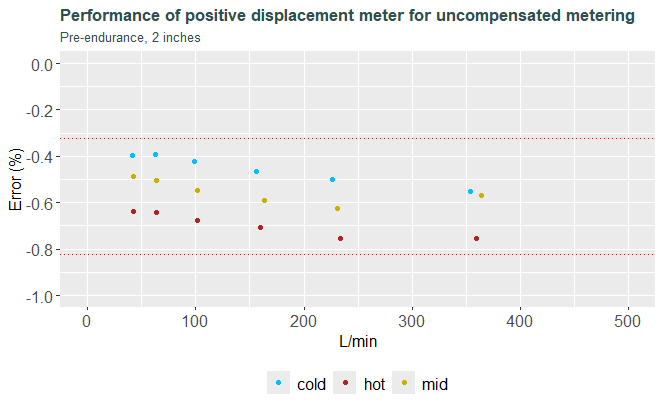
Figure 1. Pre-endurance performance of the 2 inch positive displacement meter tested with HDRD in the three temperature ranges (cold, mid and hot).
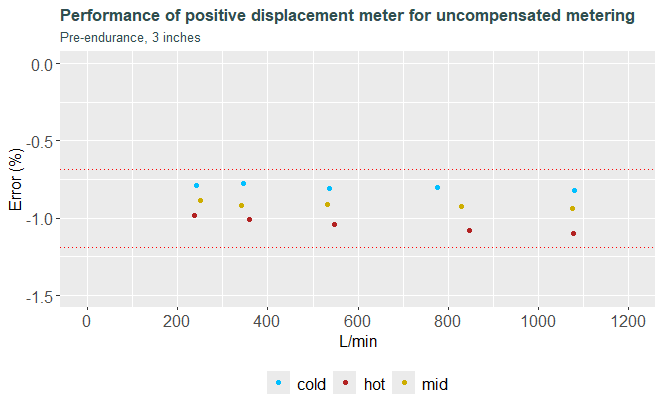
Figure 2. Pre-endurance performance of the 3 inch positive displacement meter tested with HDRD in the three temperature ranges (cold, mid and hot).
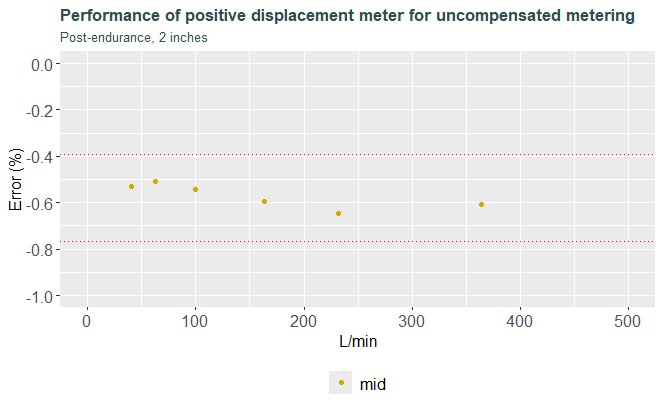
Figure 3. Post-endurance performance of the 2 inch positive displacement meter tested with HDRD at the mid temperature.
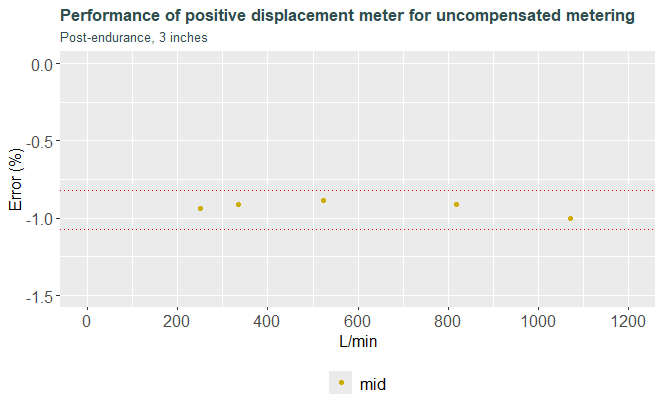
Figure 4. Post-endurance performance of the 3 inch positive displacement meter tested with HDRD at the mid temperature.
3.2 Compensated metering
3.2.1 Calculation of VCF
The experimental VCFs were compared with the theoretical values calculated with the following equation [5, 6]:

where:
- T is the temperature at which the density was measured,
- Tref is the reference temperature, 15 °C, and
- α15 is the coefficient of expansion for a specific product, defined as [2, 3]:
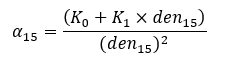
According to API Standard 2540 (1980) [5], for den15 between 787.5 kg/m3 and 770.5 kg/m3:
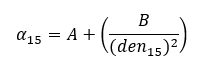
where:
- K0, K1, A and B are the group constants for a representative family of products, as defined under API Standard 2540 (1980) [5] and EN 15940:2023 [6].
The experimental VCFs were compared with the values obtained from three different exponential models:
- Model EN 15940 (also abbreviated as “EN”) calculates the coefficient of expansion with the values of K0 and K1 assigned in EN 15940:2023 [6] and the actual density of the product at 15 °C.
- Model API 2540 (also abbreviated as “API”) calculates the coefficient of expansion with the values of K0 and K1 assigned in Appendix to Table 54C, section 11.1.54.1 of API Standard 2540 (1980) [5] and the actual density of the product at 15 °C. The values of K0 and K1 depend on the density range.
- Model API 2540 standard (also abbreviated as “APIst” or “API 2540 st”) calculates the coefficient of expansion with the values of K0 and K1 assigned in Appendix to Table 54C, section 11.1.54.1 of API Standard 2540 (1980) [5] and the standardized density of petroleum diesel at 15 °C, 840 kg/m3.
The low-temperature limit set in API Standard 2540 (1980) [5] for the determination of the VCFs is –18 °C. In this analysis, we extrapolated a few VCFs below the recommended temperature limit.
The compliance of the calculated VCFs of HDRD was evaluated against both the acceptance and the in-service LOE stated in subsection 270(7) of the Weights and Measures Regulations [1].
3.2.2 Compliance rates when using pure products
Figures 8 and 9 below present the rate of compliance of the calculated VCFs for pure HDRD and petroleum diesel, respectively, based on the model used to calculate the VCFs: API, APIst or EN. The terms “approval” and “inspection” indicate the type of tolerance used to verify compliance: “acceptance limit of error” or “in-service limit of error”, respectively. For example, “API approval” means that we verified compliance using the model API and the acceptance LOE.
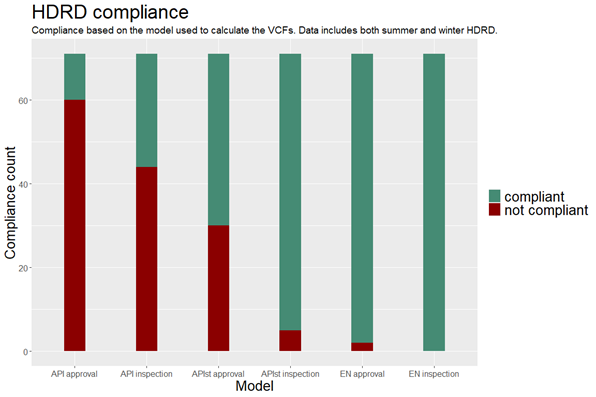
Figure 5. Variation in the compliance of the calculated VCFs for HDRD depending on the model used to calculate them.
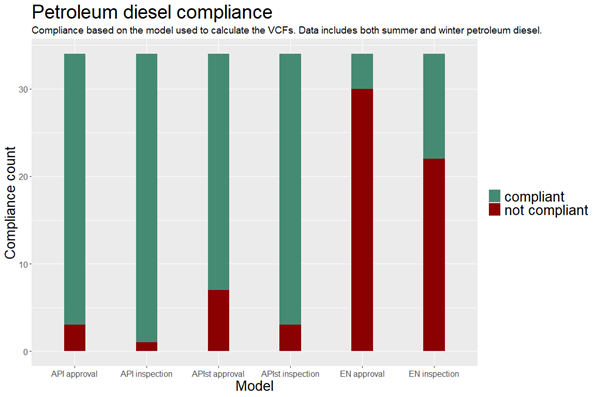
Figure 6. Variation in the compliance of the calculated VCFs for HDRD depending on the model used to calculate them.
3.2.3 Compliance rates when using blended products
The graphs in this section show the compliance of the calculated VCFs for both winter and summer blends of HDRD with petroleum diesel against model EN 15940, API 2540 st and API 2540. “Summer” and “Winter” blends refer to HDRD of the summer and the winter type, respectively, blended with traditional petroleum diesel of the same type. For example, a “summer blend” is a blend of summer HDRD and summer petroleum diesel.
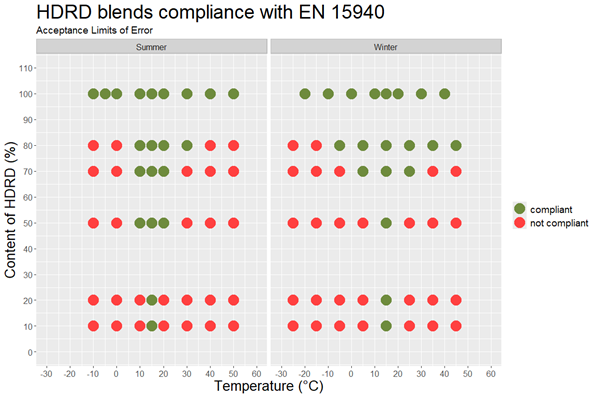
Figure 7. Variation in the compliance of the calculated VCFs for both summer and winter blends of HDRD with petroleum diesel. Model EN 15940 is used to calculate the VCFs. Compliance is evaluated against the acceptance LOE.

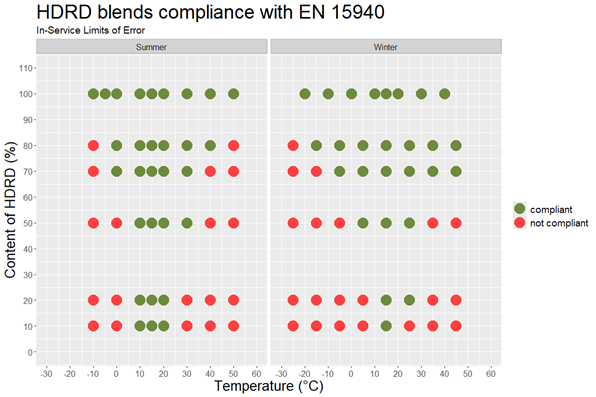
Figure 8. Variation in the compliance of the calculated VCFs for both summer and winter blends of HDRD with petroleum diesel. Model EN 15940 is used to calculate the VCFs. Compliance is evaluated against the in-service LOEs.
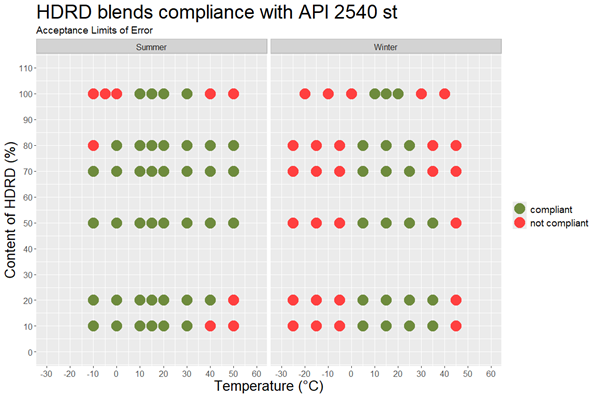
Figure 9. Variation in the compliance of the calculated VCFs for both summer and winter blends of HDRD with petroleum diesel. Model API 2540 st is used to calculate the VCFs. Compliance is evaluated against the acceptance LOEs.
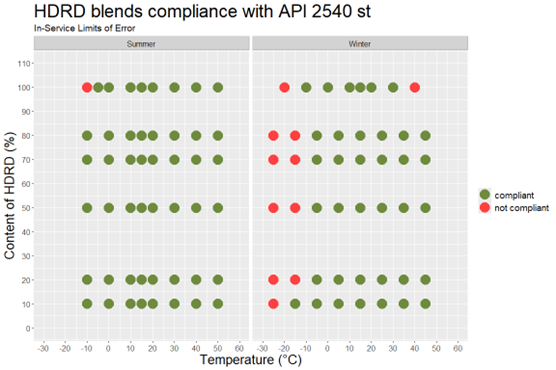
Figure 10. Variation in the compliance of the calculated VCFs for both summer and winter blends of HDRD with petroleum diesel. Model API 2540 st is used to calculate the VCFs. Compliance is evaluated against the in-service LOEs.
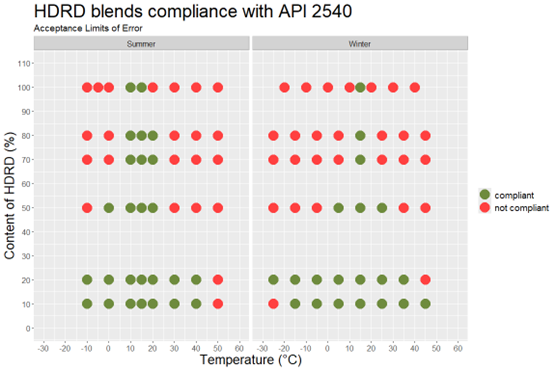
Figure 11. Variation in the compliance of the calculated VCFs for both summer and winter blends of HDRD with petroleum diesel. Model API 2540 is used to calculate the VCFs. Compliance is evaluated against the acceptance LOEs.
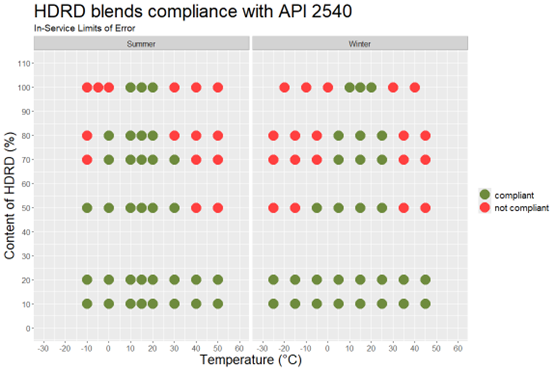
Figure 12. Variation in the compliance of the calculated VCFs for both summer and winter blends of HDRD with petroleum diesel. Model API 2540 is used to calculate the VCFs. Compliance is evaluated against the in-service LOEs.
3.2.4 Residual analysis
The analysis of the residuals provides valuable information on the fitting of the three models. The residuals represent the difference between the expected and found VCF. A model is considered a good fit for a set of data when the residuals are randomly distributed around the zero line. From the plots below, it is evident that the EN model provides the best fit for HDRD. As expected, the API model is more indicated for petroleum diesel.
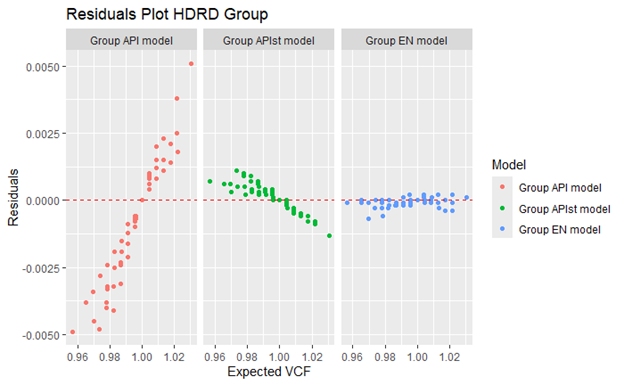
Figure 13. Residual analysis for the HDRD group. The dotted red line represent the zero line.
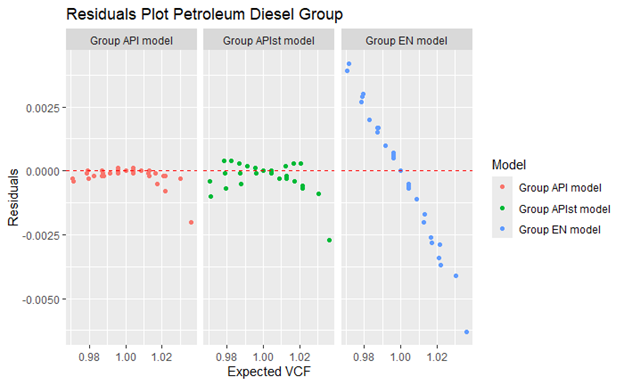
Figure 14. Residual analysis for the petroleum diesel group. The dotted red line represent the zero line.
4. Discussion and Conclusions
During the study, MC collected 44 and 97 test points for uncompensated metering of pure HDRD and compensated metering of blends, respectively. Results show that the physical and chemical differences between HDRD and petroleum diesel have a stronger impact on the compensated metering than on the uncompensated measurements. Overall, the compliance rate of the calculated VCFs for the HDRD blends with petroleum diesel is affected by:
- percentage of HDRD in the blend;
- type of HDRD (summer versus winter);
- temperature; and
- model applied to calculate the VCF.
In this section we discuss the results obtained from the study and address the two questions posed in the Introduction.
4.1 Uncompensated metering
The two PD meters tested in the studies show equivalent performances with both petroleum diesel and HDRD for both pre-endurance (Figures 1 and 2) and post-endurance testing (Figures 3 and 4). Given the similar physical properties, in particular the kinematic viscosity, of petroleum diesel and HDRD, these results can confidently be extended to all diesel replacements that meet the ASTM petroleum diesel specification D975-21 [7]. Therefore, the study suggested that it is not necessary to retest PD meters that are already approved for petroleum diesel if they are used to trade diesel replacements complying withASTM D975-21 [7].
4.2 Compensated metering
The results, based on the evaluation against the acceptance and in-service limits of error in 270(7), indicate that differences in chemical composition cause HDRD and petroleum diesel to expand and contract at different rates. While the difference between the experimental and predicted VCFs are no larger than 0.18%, they are still significant, considering that the maximum acceptance and in-service limits of error in 270(7) calculated as a percentage are 0.05% and 0.1%, respectively. For pure HDRD or high HDRD content, the use of temperature correction model for pure petroleum diesel is not adequate with the requirements set up in subsection 270(7) of the Weights and Measures Regulations [1] (Figures 5, and 9-12). Not surprisingly, the calculated VCFs for pure HDRD demonstrates higher compliance when the EN 15940 model is applied (Figures 5, 7-8, and 13), reflecting its tailored approach to diesel replacements. Similarly, the calculated VCFs for pure petroleum diesel shows higher compliance and better fitting when the traditional API models are applied (Figures 6 and 14). Given that the calculated VCFs for petroleum diesel does not show good compliance with EN 15940 (Figure 6), and that the exact blend present in the marketplace is rarely known, adopting EN 15940 would not be of practical use other than for pure HDRD transactions.
As shown in Figures 9-10, increasing the acceptance tolerance to match the in-service limits of error, in combination with the use of API 2540 st model, the most widely used ATC model, would allow the calculated VCFs of HDRD, petroleum diesel, and their blends to be adequate to compensate device metering those products.
Furthermore, the calculated VCFs for HDRD blends intended for summer exhibited a high rate of compliance using the API 2540 st model and in-service error limits (Figure 10). Given that higher HDRD blends are primarily used during the summer months due to the cloud point of HDRD, permitting compensated metering is reasonable.
In general, with both models API 2540 and API 2540 st, we observed higher rates of compliance when applying the in-service limit of error as this limit is twice as large as the acceptance limit of error (Figures 10 and 12).
We conclude that, at present, model API 2540 st, in combination with the in-service limits of error, is the most adapted model for blends of HDRD with petroleum diesel supplied in Canada.
References
[1] Weights and Measures Regulations
[3] >Bulletin V-16 – Classification of liquids for the approval of liquid meters
[4] ASTM D7042-21a - Standard Test Method for Dynamic Viscosity and Density of Liquids by Stabinger Viscometer (and the Calculation of Kinematic Viscosity)
[5] API Standard 2540 (1980) Manual of Petroleum Measurement Standards
[6] EN 15940:2023 Automotive fuels - Paraffinic diesel fuel from synthesis or hydrotreatment - Requirements and test methods