OIML BULLETIN - 2026 - VOLUME LXVII - NUMBER 4
e v o l u t i o n
Mobile verification of fuel dispensers: an integrated carbon-fibre system
Salam Mohammad Al Heyari 
Abu Dhabi Quality and Conformity Council (QCC), United Arab Emirates
Citation: S.M. Al Heyari 2026 OIML Bulletin LXVII(4) 20260409
Introduction
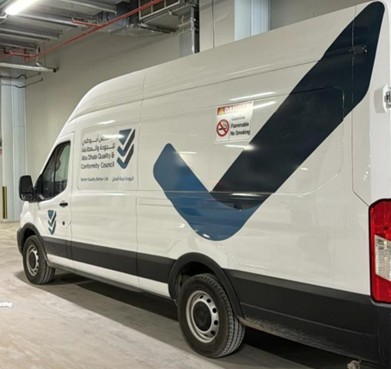
Fuel dispensers are among the most visible measuring instruments used in trade. Each quantity delivered directly affects both consumers and retailers, making reliable in-service verification a core legal metrology responsibility. In Abu Dhabi, the Abu Dhabi Quality and Conformity Council (QCC) sought to make this work faster and safer without compromising metrological assurance. The result is a customized, vehicle-mounted verification system incorporating carbon-fibre volumetric measures, a closed pipework network and on-board fuel-recovery tanks.
Development began in 2022, and the system entered service in the second half of 2023. It is now used routinely across the Emirate. The configuration accommodates four fuel types, meeting a local operational requirement that could not be satisfied by the three-type, off-the-shelf configurations identified during the procurement review. While developed to meet Abu Dhabi's specific operational requirements, the approach is relevant to legal metrology authorities facing similar challenges in field verification. The project demonstrates how established verification methods can be enhanced through system-level design, improving efficiency and safety without altering the underlying metrological principle.
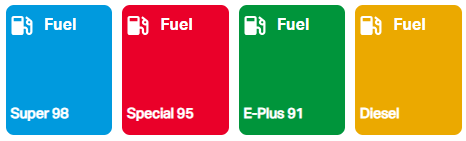
Figure 1. The four fuel types used in Abu Dhabi and accommodated by the mobile verification system, illustrating its ability to support the full range of locally available automotive fuels within a single integrated configuration.
From a handling problem to a system solution
Conventional field verification commonly uses stainless-steel volumetric measures. Carbon-fibre composite measures have low thermal conductivity, low heat expansion and are lighter to handle; however, changing the reference measure alone would not have resolved the wider operational challenge. Inspectors still had to fill, move and empty the measures repeatedly, an intensive workflow at large service stations, some of which have more than 80 fuel dispensers.
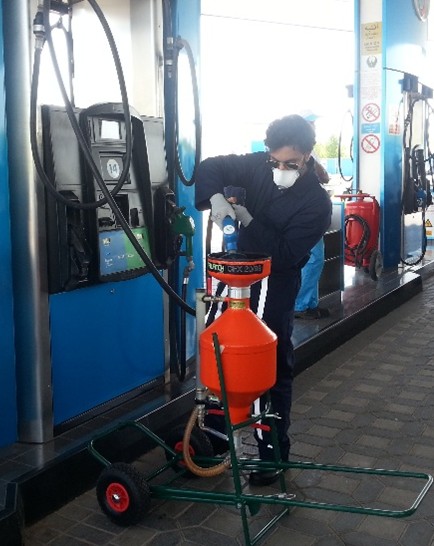
Figure 2. Conventional field verification method using a portable volumetric measure, requiring repeated filling, manual handling and fuel transfer at the service station.
QCC therefore treated the volumetric measure as one component of a complete field-verification system. The carbon-fibre measures are securely integrated into purpose-built vehicles and connected to closed pipework and on-board recovery tanks. The test fuel follows a controlled path:
Fuel dispenser → carbon-fibre volumetric measure → closed pipework → on-board recovery tank → return to underground tanks
This arrangement enables several fuel dispensers to be verified consecutively while reducing lifting, walking and manual fuel transfer. Three fully equipped vehicles provide coverage across Abu Dhabi. QCC defined the technical and operational requirements and worked with specialized engineering firms to implement them, ensuring that the vehicle functions as part of the verification system rather than merely as a means of transport.
Design strengths
- Local suitability: one mobile configuration accommodates all four fuel types used in the Emirate.
- Metrological assurance: the established volumetric comparison method is retained while handling and exposure to ambient conditions are better controlled.
- Safer operation: the closed transfer route reduces repetitive lifting, manual fuel handling and reliance on additional transfer equipment.
- Service continuity: several fuel dispensers can be verified consecutively, reducing disruption at busy service stations.
Operational impact
Operational data indicate an average reduction of approximately 40–60% in verification time per service station. QCC teams now verify more than 6,300 fuel dispensers annually at approximately 282 fixed and mobile service stations. Faster completion improves regulatory coverage using existing resources, reduces disruption to station operations and gives inspectors more time to address non-conforming instruments during the same visit. Beyond reducing verification time, the system improves the efficiency of regulatory service delivery by allowing inspection resources to be deployed more effectively. This demonstrates how operational innovation can strengthen market oversight while maintaining established metrological assurance practices.
| Indicator | Result |
|---|---|
| Fuel dispensers verified annually | More than 6 300 |
| Stations covered | 282 |
| Fuel types accommodated | 4 |
| Average verification-time reduction | Approximately 40% to 60% |
| Operational status | Daily use across Abu Dhabi |
| Reported operational incidents | None since deployment |
Safety was treated as a design requirement rather than a secondary benefit. By keeping the test fuel within an integrated transfer route and reducing repeated movement of filled measures, the system lowers manual-handling demands and the risk of spillage. Inspectors have reported a more manageable workflow, and QCC recorded no operational incidents associated with the system from deployment to the date of submission.
Lessons for legal metrology authorities
The project shows that innovation need not replace an established measurement principle. It can instead improve the way a trusted reference measure is deployed. The most transferable lessons are to design for actual field conditions, define local requirements before procurement, treat handling and fuel routing as integral parts of the verification system, and assess innovation through repeatable operational outcomes rather than novelty alone.
This systems-based approach is consistent with the scope of OIML R 117:2019, which addresses dynamic measuring systems for liquids other than water, including fuel dispensers, their metrological controls and performance tests. In practice, technical performance must be supported by procedures and operating arrangements that maintain confidence under actual conditions of use.
Recognition and next steps
In 2026, the system received a Bronze Stevie® Award in the category “Award for Excellence in Innovation in Government”. More importantly, it has progressed beyond the prototype stage into routine regulatory service. Future development could build on this platform through increased automation, digital recording, traceability and data analytics for risk-based market surveillance.
For QCC, the central outcome is clear: a conventional verification task has been redesigned as an integrated service that combines metrological assurance, local adaptability, safety and efficiency. The experience demonstrates that meaningful innovation in legal metrology can be achieved by improving the way established measurement principles are applied in practice. For authorities seeking to increase efficiency and safety in field operations, a systems-based approach offers a practical pathway for strengthening regulatory outcomes while maintaining confidence in measurement. Each verified delivery is a small transaction, but together these measurements sustain confidence in the marketplace.
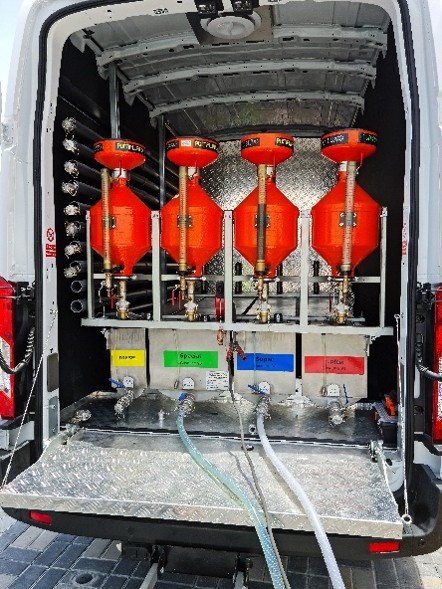
Figure 3. Interior view of the vehicle, showing the arrangement of the volumetric measures, connecting pipework, valves and supporting fuel-handling equipment.
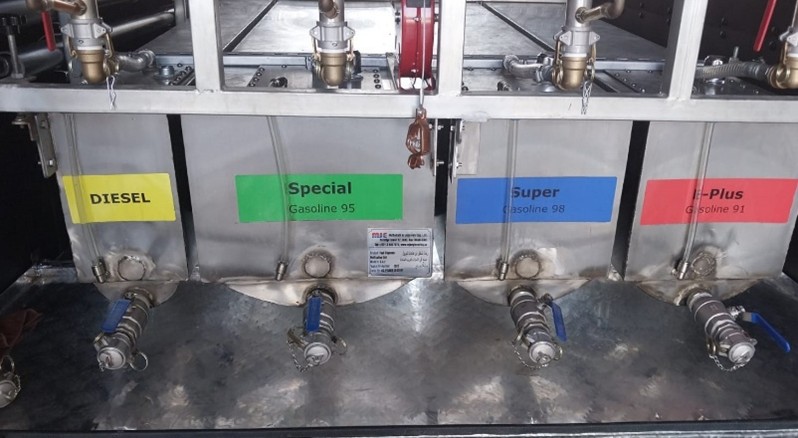
Figure 4. Closed pipework directing the test fuel from the volumetric measure to the on-board recovery tank, thereby reducing manual transfer and the risk of spillage.