OIML BULLETIN - 2026 - VOLUME LXVII - NUMBER 3
f o c u s p a p e r
The European voluntary modular approach to the type-examination of weighing instruments
Under Directive 2014/31 on the harmonization of the laws of the Member States relating to the making available on the market of non-automatic weighing instruments
Ian Turner

CECIP 
Citation: I. Turner 2026 OIML Bulletin LXVII(3) 20260308
Introduction
The model used by European Governments to ensure the legal conformity of weighing instruments has historically been carried out in two stages; the first stage being an assessment to type where the design of the instrument was compared to a set of agreed standards or specifications. The second stage is a verification process where a given instrument was tested by an approved body to ensure that it complied with selected aspects of the conformity to type before it could be placed on the market.
This two-stage model of conformity goes back many decades and is broadly similar in different national legislations. In the UK, for example, it took form in the Weights and Measures Act 1963 [1] with sections 11 and 12 of that Act; section 12 outlining approved patterns of equipment and section 11 requiring certain equipment to be tested and stamped by an inspector before it can be used for trade. This model became clearly defined in the EU Aquis that governed the placing of products on the single market in what is referred to as “The New and Global Approach” [2]. This separated the process of placing products on the market into two complimentary pillars; The New Approach created the principle of essential requirements for products [3] and the Global Approach created the rules and assessment procedures that must be followed to ensure an instrument complies with the essential requirements of the legislation.
The concept of the Global Approach is illustrated in Figure 1, where we can see the different conformity assessment modules [4] that are available to a manufacturer of products regulated by EU Product legislation. The assessment procedures that are of interest to us in this discussion are Module B where specimens of the type will be assessed for compliance with the essential requirements by a notified body [5]. Module B must always be followed by a second module; in this discussion we will focus on Module D which is the conformity to EU-type based on quality assurance of the production process. This is a procedure where the manufacturer of a product operates a quality assurance system in order to ensure conformity to EU type of individual instruments. The quality assurance system will also have to be certified by a notified body. After the completion of both modules a manufacturer can apply the conformity assessment marks to a product, issue a Declaration of Conformity [6] and legally place the instrument on the market.
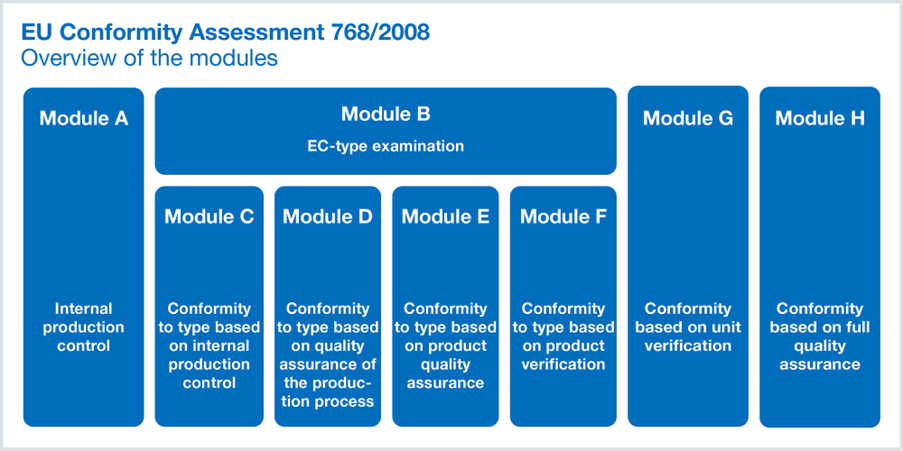
Figure 1. Conformity Procedures available to manufacturers under the New and Global Approach Directives
Conformity assessment procedures under the Directive 2014/31.
The present EU Directive 2014/31 relating to non-automatic weighing instruments is a recast of the original Directive 90/384 and outlines the conformity assessment modules available to manufacturers intending to place non-automatic weighing instruments on the market. This directive offers a limited range of modules with the majority of instruments being placed on the EU market by manufacturers using Module B followed by Module D, or in some cases Module B followed by Module F [7].
This procedure works well for weighing instruments where the assumption is that the instrument is a tangible and discrete unit which can be conformity assessed in the form that it will be placed on the market; for example, a small NAWI which contains all of its components inside one outer container and an indicator mounted on the outside of the instrument. There would be thousands of such instruments in retail outlets where goods would be weighed by the shop keeper on a price-computing scale with no connection to a wider network. The type-examination process for such scales would enable an assessment of the unit against the harmonized standard [8] EN45501 (2015) and the certification issued appropriately.
This underlying assumption has been challenged when weighing instruments became more modular in nature. Customers began to demand instruments to which separate modules [9], or peripherals [10] could be added. This change in demand was precipitated by two main drivers: firstly the trend towards greater integration of weighing instruments into computer networks, and secondly the change in the nature of manufacturing processes for some weighing instruments. The trend of integration can be most clearly seen in the retail environment; customers such as supermarkets wanted their weighing instruments connected to point of sale systems (POS systems), sophisticated tills and the “back office” of the business. This would necessarily involve weight data being further processed in different modules of the integrated instrument; price per weight being calculated in the POS system rather than the scale for instance. The second trend is the change of manufacturing processes that can be seen in industrial weighing with high-capacity instruments such as weigh-bridges; a small business would purchase components such as indicators and load cells and combine them in their own fabrication plant to make the completed instrument, this would lead to them assuming the responsibility of the manufacturer [11], although in reality they have merely assembled the instrument using components manufactured elsewhere.
These changes clearly demonstrated a need to ensure that the type-examination process remained relevant and legislative frameworks reflected the nature of the market. This was addressed when WELMEC [12] produced the voluntary modular approach.
WELMEC and the Modular Approach
The Voluntary Modular approach was developed around 2008 to reflect the need for certification of modules and peripherals in their own right. These individually certified parts could be incorporated into a complete weighing instrument with the individual modular certificates being referenced in the type-examination certificate. The process, recognizing the development and use of peripherals and modules, bought greater flexibility, transparency and confidence to the market and has been successfully used for many years,
WELMEC 8.8: Guide on the General and Administrative Aspects of the Voluntary System of Modular Evaluation of Weighing Instruments (2017) MID-NAWI
This is the main document with respect to the modular approach. It recognizes that if a manufacturer builds the several parts together into a complete instrument, they can be evaluated separately with respect to their specific function as part of the complete design. If such a part both fulfils the functional aspects of a measuring instrument and conforms to the applicable OIML recommendations, harmonized standards, normative documents and/or WELMEC guides, a certificate illustrating such compliance can be issued. The Voluntary Modular approach anticipates three different types of certificates. The first is what is known as a test certificate (TC). These were originally to implement the modular approach for the purposes of the Directive 2009/23/EC [13] but have been superseded with parts certificates (PC) and evaluation certificates (EC). This occurred when the Directive 2009/23/EC was recast to 2014/31 and it was decided to harmonize the terminology with the Measuring Instruments Directive 2014/32 [14]. An evaluation certificate (EC) is a document that describes the metrologically relevant characteristics of a part of a measuring instrument, including its compatibility with other parts. A parts certificates (PC) ostensibly serves the same function but allows for general acceptance in a type of examination certificate. PCs have become very common in the market and serve an important function in ensuring the market operates properlly.
WELMEC 2.10: Technical Implementation of the Modular Evaluation for Non-Automatic Weighing and Automatic Weighing Instruments
This guide focuses on the modular approach for NAWIs and AWIs and is a useful and comprehensive extension of the ideas outlined in WELMEC 8.8. It includes a long list of the components that are eligible for either parts or evaluation certificates. This list is broken down into three broad categories. Firstly, load cells and parts that include load cells. This category includes the weighing module. The second part of the list covers parts with analogue-to-digital conversion devices without an indicator and the third part covers purely digital parts. The majority of the components listed in the guide reflect the modules that are listed in EN45501 (T.2.2) and it is important that both documents are read in conjunction with each other. The Guide 2.10 also introduces the idea of the general acceptance of certain components; at the time of writing this covers only analogue load cells and simple recipient printers.
WELMEC 2.2: Guide for Testing Point of Sale (POS) Devices (Non-Automatic Weighing Instruments)
This guide was published at approximately the same time as the original WELMEC 8.8 and is very useful in understanding the implications for non-automatic weighing instruments having POS systems connected to them. It recognizes the POS as a separate module and permits what is referred to as the ‘open’ modular approach which allows the possibility of connecting a POS with a TC (and now presumably an EC or PC) to the NAWI. Most importantly it requires that the combined instrument of NAWI and POS must be conformity assessed before it can be placed on the market and that a declaration of conformity is issued for the combined modules.
The last aspect of the modular approach that needs to be considered is what is known as the ‘Compatibility of Modules’. This is the method by which the manufacturer must demonstrate that the choices of load cell and indicator operate together as a complete instrument and is achieved by the completion of a compatibility of modules form. There are ten conditions outlined in the form that the complete instrument must meet before it can be placed on the market. The data for the compatibility form is invariably found in either the type-examination document of the subsidiary TCs, ECs or PCs and is entered into the form to determine whether the criteria are met.
CECIP view of the modular approach
CECIP is the European Association of Weighing Instrument Manufacturers [15] and is firmly of the view that the modular approach has bought flexibility and dynamism to the market. It can save cost and time in getting products to the consumer and brings confidence to all stakeholders. It is likely to become even more significant in the future as weighing instruments become increasingly integrated in production and manufacturing processes. CECIP is of the view that the value of the modular approach could be further enhanced if the notion of general acceptance was extended beyond load cells and simple recipient printers to include other modules and peripherals. CECIP is also very supportive of the ongoing discussions to introduce a similar approach into the OIML Certificate system. The benefits the modular approach has bought to the market outweigh any potential drawbacks and it reflects that when all stakeholders work together a model that reflects the needs of everyone can be produced.
Notes and References
[1] https://www.legislation.gov.uk/ukpga/1963/31/enacted
[2] This is explained in detail in The ‘Blue Guide’ on the implementation of EU product rules 2022. https://single-market-economy.ec.europa.eu/news/blue-guide-implementation-product-rules-2022-published-2022-06-29_en
[3] Essential requirements are the legally binding, high-level safety and performance objectives that products must meet to be legally sold in the European market.
[4] The EU Legislation refers to the different conformity assessment procedures as modules. These are outlined in the Decision 768/2008 (https://eur-lex.europa.eu/eli/dec/2008/768(1)/oj/eng)
[5] A Notified Body is an independent, third-party organization designated by an EU member state to assess whether a product meets the essential requirements
[6] The Declaration of Conformity is a statement by the manufacturer that the product meets all the relevant legislative requirements that apply to it.
[7] It is also possible to use Module D1 or F1 for instruments without electrical or electronic elements (they will not necessitate a module B type-examination) or module G for ‘one off’ instruments
[8] A harmonized standard is a standard recognized as giving a presumption of conformity with the essential requirements of the directive
[9] Identifiable part of an instrument that performs a specific function or functions, and that can be separately evaluated in accordance with specific metrological and technical performance requirements in the relevant standards. The modules of a weighing instrument are subject to specified error limits (EN45501(2015)(T.2.2)
[10] Additional device which repeats or further processes the weighing result and other primary indications (EN45501(2015)(T.2.3.5)
[11] The manufacturer is any natural or legal person who manufactures an instrument or has an instrument designed or manufactured, and markets that instrument under his name or trademark
[12] WELMEC is a representative organization of national legal metrology authorities. It seeks to harmonize the practices of legal metrology and promote their effective use
[13] https://eur-lex.europa.eu/eli/dir/2009/23/oj/eng