OIML BULLETIN - VOLUME LXVI - NUMBER 4 - October 2025
e v o l u t i o n
Measuring Legal Metrology Competency Across Countries
Ann-Sara Ramkissoon
University of Florence  , Italy
Citation: A-S Ramkissoon 2025 OIML Bulletin LXVI(4) 20250403
1. Introduction
Over a two-week period, from 12–23 May 2025, I visited the International Bureau of Legal Metrology (BIML) in Paris with the objective to examine the availability of and collect data for measuring legal metrology capability at the country level. The challenge was to identify indicators that demonstrate the presence and level of legal metrology development across as many countries as possible, while also providing a reasonable level of granularity within the constraints of data availability, particularly given the target to develop a time series dataset and generate usable data for economic analysis.
Legal metrology development is essential for ensuring fairness, transparency, and safety in both domestic markets and international trade. Accurate and reliable measurements underpin consumer protection, equitable commercial transactions, regulatory compliance, and public health and safety. As economies grow more complex and interconnected, the role of legal metrology expands - from verifying weights and measures in trade to ensuring accuracy in medical devices, environmental monitoring, and fuel dispensing. Strengthening legal metrology systems contributes to market efficiency, reduces transaction costs, supports industrial competitiveness, and builds trust between consumers and producers. For developing countries in particular, investing in legal metrology is a critical enabler of economic integration and sustainable development.
Therefore, it is essential to measure the presence and development of legal metrology in order to understand how well countries are equipped to support fair trade, consumer protection, and regulatory enforcement through reliable measurement systems. Without clear metrics, it is difficult to assess the effectiveness of legal metrology institutions, identify gaps in capacity, or track progress over time. Reliable indicators help policymakers, development partners, and international organizations design targeted interventions, allocate resources efficiently, and benchmark progress across countries. Moreover, measuring legal metrology development enables its integration into broader economic and development analyses, highlighting its role in reducing transaction costs, improving market functioning, and enabling compliance with international trade requirements. In short, robust measurement of legal metrology systems provides the evidence base needed to strengthen them and maximize their contribution to national development goals.
While I was able to identify several potential indicators, each comes with significant limitations. The current data landscape is limited not only by a lack of depth and consistency but also by issues related to accessibility and coverage. Much of the historical data for key legal metrology indicators remain undigitized, making systematic collection and analysis difficult. Furthermore, some indicators only cover a small subset of countries or reflect legal metrology activities where only a limited number of countries are involved, making them ineffective as global indicators. In certain cases, countries may formally sign up for specific initiatives or programs but demonstrate limited active engagement, which complicates the interpretation and reliability of these indicators. As a result, the available data does not fully capture the presence, development, or operational effectiveness of legal metrology systems globally. Further work is required to improve data quality, enhance accessibility, and develop more robust, comprehensive indicators that can support meaningful cross-country comparisons and inform policy decisions.
2. Legal Metrology Indicators: Possibilities and Constraints
2.1. OIML Membership
The first indicator I examined was membership to the International Organization of Legal Metrology (OIML), given the organization's role as the international coordinator in this field and the broad participation of economies in its activities. Economies would be assigned a score based on their type of OIML membership: Member States would receive a score of 2, Corresponding Members a score of 1, and non-members a score of 0. This information is available on the OIML’s website.
Data Availability and Accessibility
Several limitations emerged upon closer examination. While current membership data is available, constructing a reliable time series is challenging due to gaps in historical records and limited documentation of changes in membership status over time. To create a time series dataset reflecting OIML membership, it is necessary to know the year countries became Member States or Corresponding Members. Currently, this information is publicly and digitally available only for Member States. For corresponding members, however, the data is not digitized and remains accessible only in paper format in the archives at the BIML.
Another challenge is that some economies have changed their membership status over time, but comprehensive data on these changes is not readily available. For example, Guinea [1] was previously a Member State but is now a Corresponding Member, while Viet Nam transitioned from Corresponding Member to Member State. Additionally, some economies maintained a form of OIML membership for several years before being delisted, and others have experienced multiple cycles of delisting and relisting. The exact years these changes occurred have not systematically been recorded in digital formats; much of this information remains buried in paper archives at the BIML.
Indicator Suitability Assessment
OIML membership is not a reliable indicator of an economy’s legal metrology development or competency. Membership primarily reflects an economy’s willingness to engage with the international legal metrology community, rather than its actual technical capacity or institutional maturity. While Member States must ratify the OIML Convention and pay annual contributions, there is no formal assessment of whether they maintain effective legal metrology frameworks, enforcement mechanisms, or technical infrastructure. Engagement levels vary widely; some countries actively participate in technical work and the OIML Certification System (OIML-CS), while others have minimal involvement or implementation of OIML Recommendations. Corresponding Members may have strong legal metrology systems but remain outside full membership due to political or budgetary reasons. Participation in the OIML-CS is voluntary and limited to a subset of countries, underscoring that membership status alone does not reflect actual competency.
Additionally, membership classifications lack the granularity needed for meaningful economic analysis. Simply categorizing countries as Member States, Corresponding Members or non-members fails to capture important variations in institutional capacity, regulatory enforcement, and technical engagement. Without detailed indicators, critical differences in how legal metrology systems function are obscured, risking oversimplification and misleading conclusions about their economic impact.
It is also important to note that non-membership does not imply the absence of legal metrology. Countries can adopt OIML Recommendations without being members, as these documents are freely accessible. Moreover, some countries have been delisted but may still maintain legal metrology systems.
2.2. Participation in the OIML-CS
Launched in 2018, the OIML Certification System (OIML-CS) is a voluntary international system for issuing, registering, and using OIML Certificates and type evaluation reports for measuring instruments, based on OIML Recommendations. It replaced the former OIML Basic Certificate System and Mutual Acceptance Arrangement. The OIML-CS supports national and regional authorities in streamlining type evaluation and approval processes of measuring instruments subject to legal metrological control and helps instrument manufacturers demonstrate compliance with international requirements where relevant. There are two main forms of participation under the OIML-CS - Issuing Authorities or Utilizers or both. The system includes two schemes: Scheme A (based on accreditation or peer assessment) and Scheme B (based on self-declaration). Participation is open to OIML Member States and Corresponding Members that commit to accepting and utilizing OIML type evaluation and test reports, when associated with an OIML Certificate issued by an OIML Issuing Authority, for type approval or recognition in their national or regional metrological controls (cite OIML CS pdf).
A potential scoring system based on the OIML Certification System (OIML-CS) could assign countries a score according to their level of participation. Issuing Authorities could be assigned a score of 2, Utilizers a score of 1, and non-participants a score of 0. However, this basic classification should be refined to signal the depth of participation. For Issuing Authorities, the number of scopes covered (e.g., 1 vs. 23 out of 27 possible) should be factored in. Similarly, for Utilizers, the scheme under which they participate - Scheme A (peer-assessed or accredited) versus Scheme B (self-declared) - and the number of scopes should be reflected in their score. Without incorporating these nuances, the scoring system may misrepresent the actual level of legal metrology competency.
Data Availability and Accessibility
Upon closer analysis, I identified some limitations of using the OIML-CS as a proxy for legal metrology development. First, only current participation data is publicly available on the OIML website. Historical records on when countries became Utilizers or Issuing Authorities, as well as the specific scopes and schemes they participate in, have not been systematically compiled by the BIML. While some of this information may be retrievable from the minutes of OIML-CS Management Committee meetings (not published online) or CIML meeting documentation (partially available on the OIML website), extracting and structuring this data would require considerable effort – assuming it is all available.
Second, the OIML-CS only began in 2018, which limits the length of any potential time series. As most economic analyses require data spanning at least 20-30 years, this restricts its immediate usefulness for such purposes.
Finally, participation in the OIML-CS is still relatively limited, which poses challenges for cross-country analysis. As of May 2025, only 37 economies were listed as Utilizers, 13 of which also serve as Issuing Authorities. Where an organization becomes an OIML Issuing Authority under Scheme A, the OIML Member State must designate at least one Utilizer for that category of measuring instrument. Therefore, issuers also appear as utilizers. This small sample may constrain the generalizability of findings and reduce statistical robustness in broader analyses.
Indicator Suitability Assessment
Participation in the OIML-CS could be considered a strong indicator of legal metrology competence because it requires countries to demonstrate technical capability, institutional maturity, and adherence to international standards. Under Scheme A of the OIML-CS, participating economies and their associated test laboratories must undergo peer assessment or accreditation, ensuring that they meet rigorous competence requirements. Participation also implies that national systems are equipped to evaluate, approve, and recognize measuring instruments in line with OIML Recommendations – functions that demand a high level of legal, technical, and administrative infrastructure.
2.3. Involvement in OIML Technical Committees, Subcommittees and Project Groups
Technical Committees (TCs) are established to address broad issues in legal metrology, with Subcommittees (SCs) formed under TCs to focus on more specific topics. Within both TCs and SCs, Project Groups (PGs) may be created to work on targeted issues. Each structure allows for different levels of participation: Conveners, Participants, and Observers. A scoring system can be applied to reflect engagement levels – for example, 3 points for Conveners, 2 for Participants, 1 for Observers, and 0 for non-participation.
Data Availability and Accessibility
Current data is not publicly available in a format suitable for statistical analysis. While participation information for TCs, SCs, and PGs is accessible on the OIML website, it must be retrieved manually by navigating through each level (TC → SC → PG), which makes data collection cumbersome. Time series data is also not publicly available, as key information on the start and end dates of their different phases of activity (e.g., Phase 1, Phase 2) is not published online. Additionally, the timing of when countries joined or exited these groups is also not publicly accessible. However, during my visit to the BIML, I was able to access this information through their internal digital database, which includes data from 2000, offering a reasonable time series. Still, further verification of the dataset by the BIML is required before it can be used confidently.
Indicator Suitability Assessment
Participation in TCs, SCs, and PGs offers some insight into a country's legal metrology competency, particularly when a country takes on active roles such as convener or participant. These roles suggest a certain level of technical capacity and institutional interest. However, participation does not always translate into meaningful involvement. In practice, some countries may be listed as participants or even conveners but contribute little to the actual work. Moreover, participation in these committees/ groups does not necessarily reflect the state or effectiveness of a country’s national legal metrology system. As such, while committee involvement can serve as a complementary indicator, it should be interpreted cautiously and used alongside other metrics.
2.4. OIML Surveys on the State of Legal Metrology and use of OIML Recommendations in Member States and Corresponding Members
More than two decades ago, the BIML undertook an initiative to collect information on the state of legal metrology development across Member States and Corresponding Members. A detailed questionnaire was mailed in paper format to participating economies, covering the following areas: 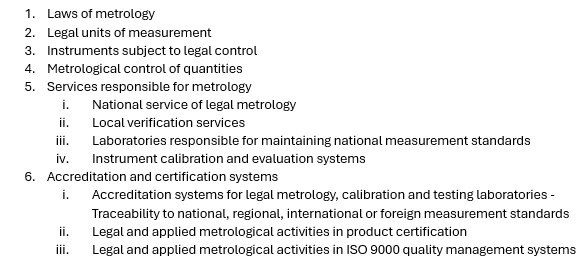
The last edition of this survey was published in 1996 with information on 54 Member States and 37 Corresponding Members. Where updated responses were not provided by Member States or Corresponding Members, data from the 1990 edition was used. The survey was ultimately discontinued due to low participation from Member States and Corresponding Members.
Another survey was previously conducted, distributed in paper format via mail, on the OIML Recommendations used by Member States and Corresponding Members. However, no record of this survey or the results were found during my visit. It is likely stored in the BIML archives and would need to be retrieved from there.
Data Availability and Accessibility
Given that both surveys were discontinued, no current data is available. The data is not publicly accessible, and the only known edition of one survey is the 1996 version, which exists only in paper format. As for the other survey, no records were found during my visit. It remains unclear how many editions were conducted in total or how many are still preserved in the BIML archives.
Indicator Suitability Assessment
The surveys have the potential to offer rich sources of data, covering key areas such as legislation, institutional arrangements, technical infrastructure, and the use of OIML Recommendations. Both could be updated and shared with economies affiliated with the OIML, as well as non-member countries, to understand the state of development there. If maintained and updated regularly, it could provide strong indicators of legal metrology development and institutional capacity at the national level. Future surveys should be conducted digitally using online survey tools to ensure easier distribution, higher response rates, and more efficient data processing.
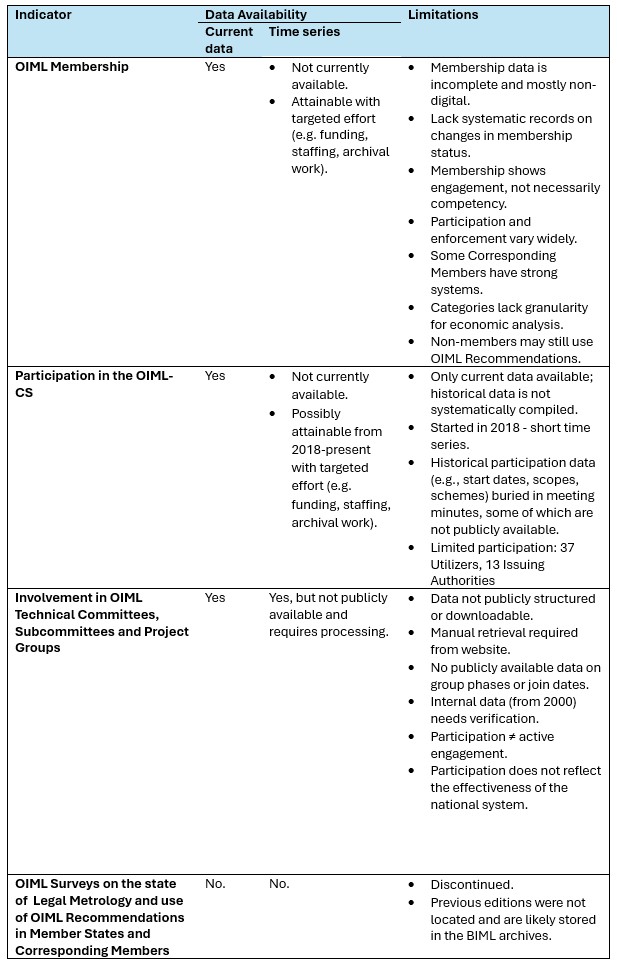
Table 1 summarizes the potential country-level indicators discussed and their limitations.
Table 1: Summary of potential country-level indicators of legal metrology competency and their limitations.
3. Recommendations
The following recommendations arise from the findings of this research:
3.1. Develop a Composite Indicator
None of the individual indicators currently available or attainable, such as OIML membership status, participation in technical work, or involvement in the OIML-CS, are sufficient on their own to capture the complexity of legal metrology competency at the national level. For example, OIML membership signals formal engagement with the international legal metrology community but says little about actual implementation or enforcement capacity. Participation in technical work may suggest expertise or institutional interest, but not all countries listed as participants are actively involved. Similarly, while the OIML-CS highlights countries that are applying harmonized standards, it involves only a limited number of economies and technical scopes.
To achieve the granularity, coverage, and analytical strength required for meaningful cross-country comparisons and economic analysis, a composite indicator incorporating the 3 proxies should be developed. Such a composite metric would help distinguish between countries that are nominally engaged and those that demonstrate robust implementation. It would also support more reliable econometric analysis of the role legal metrology plays in enabling trade, protecting consumers, and lowering compliance costs. However, the data required to construct this indicator must still be systematically collected and verified.
3.2. Digitize Archived Data
The BIML archives contain valuable historical data on legal metrology, participation trends, and institutional developments that are not currently accessible in usable formats. To support research and evidence-based policymaking, this archival material should be prioritized for digitization. Making these records available in structured, machine-readable formats would greatly enhance the ability to build time series datasets, track institutional progress over time. This initiative would require dedicated resources and collaboration with the BIML but would be a strategic investment in long-term data infrastructure.
3.3. Relaunch the OIML Legal Metrology Survey
An updated survey on the status of legal metrology systems would be a valuable tool for collecting data on legal frameworks, institutional structures, technical infrastructure, and the adoption of OIML Recommendations. To ensure usability and broad participation, the survey should be redesigned in digital format using accessible tools such as Google Forms or a similar online platform.
Survey questions should be clearly structured, with dropdown menus and tick boxes where appropriate - for example, to capture which versions of OIML Recommendations are being used. The design should minimize reporting burdens while maximizing data quality and comparability. The survey should also allow for the inclusion of non-OIML members, thereby expanding its relevance and coverage.
If conducted periodically and well-maintained, this survey could become a foundational tool for tracking legal metrology development across a wide range of economies.
4. Conclusions
This paper has examined the strengths and limitations of various proxies, for which data is currently and potentially available, to assess legal metrology competency at the national level. These include OIML membership, participation in technical work, and involvement in the OIML-CS. While each of these indicators offers some insight, none is sufficiently robust or comprehensive on its own to capture the complexity of legal metrology systems across countries. Moreover, data gaps, especially around historical participation and implementation, further limit their analytical value. To address these shortcomings, this paper recommends developing a composite indicator that integrates multiple dimensions of legal metrology capacity. Achieving this will require improved data collection efforts, such as the digitization of archival records. In addition, the revival of standardized, digital surveys could help deepen our understanding of legal metrology competency at the country level and improve the data landscape. Taken together, these steps can lay the foundation for a more evidence-based understanding of legal metrology’s role in supporting trade, consumer protection, and regulatory effectiveness globally.
5. References
[1] Guinea became a Member State in 1959 but stopped paying its contributions in 1984 and was officially delisted in 1990. Guinea expressed interest in rejoining the OIML in 2008, and a formal request was submitted to the CIML in 2010, which was declined at the time. Guinea was ultimately readmitted as a Corresponding Member in 2013 Minutes of the 48th CIML Meeting (2013)
OIML publications, other references, other attempts, similar attempts in other fields, AIQI...