OIML BULLETIN - VOLUME LXVI - NUMBER 4 - October 2025
e v o l u t i o n
Celebrating 70 years of the OIML
Anthony Donnellan  and Janet R. Miles
BIML 
Citation: A. Donnellan and J.R. Miles 2025 OIML Bulletin LXVI(4) 20250401
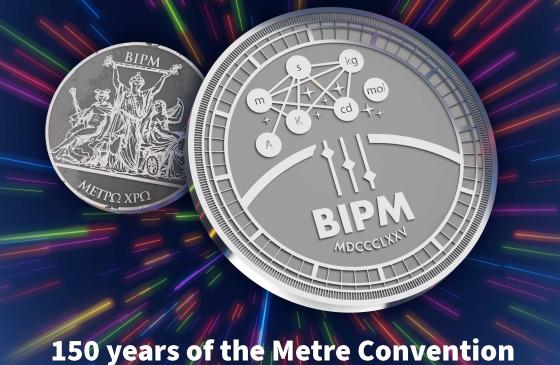
The year 2025 is an auspicious one for metrology as we look back on 150 years since the signing of the Metre Convention and 70 years since the creation of the International Organization for Legal Metrology (OIML).
Measurements underpin so many aspects of daily life that they are often taken for granted, but ensuring their reliability is not only of interest to scientists but is fundamental for trade, ensuring consumer protection, and ensuring our health and safety. Metrology – the science of measurement - sets the framework for reliable and consistent measurements around the world. In this article we trace the development of the International System of Units (SI) and review some of the landmark decisions in the development of today’s metrology infrastructure.
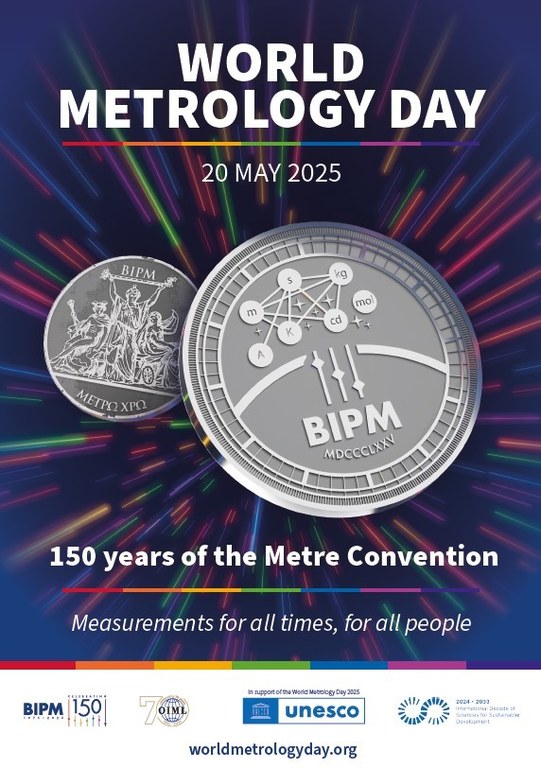
The metric system was established in France through a national law passed in 1795, and platinum standards representing the metre and the kilogram were deposited in the national archives of France in 1799. Nearly 70 years later, during the International Exhibition in Paris in 1867, a Comité des poids, mesures et monnaies (Committee for weights, measures and moneys) called for international adoption of the metric system, and in 1869 Napoleon III, encouraged by the Bureau des longitudes, the French Academy of Sciences, and the Academy of Saint Petersburg, initiated the international discussions that led – through the work of the International Metre Commission (1870, 1872) - to the Diplomatic Conference of the Metre and the signing of the Metre Convention in Paris on 20 May 1875. It is in recognition of this date that 20 May is now celebrated as World Metrology Day. Since 2024 it is celebrated as an international day observed by UNESCO.
The Metre Convention established the first permanent organizational structure for member governments to act together on matters relating to measurement science. It established the General Conference on Weights and Measures (CGPM) consisting of the delegates of all the contracting governments, an International Committee for Weights and Measures (CIPM) composed of eminent metrologists from different Member States to supervise the work undertaken, and the International Bureau of Weights and Measures (BIPM) with headquarters near Paris.
Initially the scope of the Metre Convention was limited to measurements of mass and length (with associated measurements of temperature). Prototype metres and kilograms were fabricated in a platinum-iridium alloy and distributed to the Member States, and international prototypes were sanctioned by the 1st CGPM (1889) and deposited at the BIPM. Indeed, these international prototypes are still maintained at the BIPM under the conditions specified by the 1st CGPM – even though the definitions of the metre and kilogram have subsequently evolved and are now independent of the artefacts.
It soon became evident that there was a need for international agreement on measurement units in other domains, and in 1921 the Convention was amended to broaden its scope to other fields. The CIPM set up Consultative Committees to advise it on different areas of metrology. The first of these was the Consultative Committee for Electricity (now the Consultative Committee for Electricity and Magnetism), which first met in 1928. The Consultative Committee for Photometry (now the Consultative Committee for Photometry and Radiometry) first met in 1937, and the Consultative Committee for Thermometry first met in 1939. In 1954 the CGPM approved the definitions of the ampere, the kelvin and the candela as units for electric current, thermodynamic temperature and luminous intensity respectively. The Consultative Committee for the Definition of the Second (now the Consultative Committee for Time and Frequency) first met in 1956, and in 1960 the CGPM adopted a new definition of the second as the base unit for time.
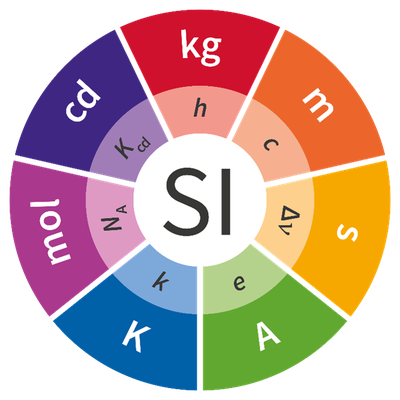
At that same meeting, the 11th CGPM adopted the name International System of Units (SI) for the system based on the six base units: the metre, kilogram, second, ampere, kelvin and candela. A seventh base unit, the mole, for amount of substance, was added by the CGPM in 1971. During the 26th CGPM (2018), the Member States of the BIPM voted unanimously in favour of a major evolution of the SI, such that from 20 May 2019 all SI units are defined in terms of constants that describe the natural world. This fulfils one of the early aims of the metric system - that the measurement units be defined by natural phenomena rather than by physical artefacts - and enables the use of quantum technologies to implement the definitions. Full information about the SI is published by the BIPM in the SI Brochure.
By the early 1930s it was already clear that in addition to international agreement on units there was a need for international compatibility in the trade of measuring instruments. Although largely based on the metric system, national statutory and regulatory requirements for measuring instruments were not necessarily compatible internationally. In 1933 it was proposed that the CIPM create a Consultative Committee for Applied Metrology to address such issues, but after much discussion it was decided that this was outside the scope of the Metre Convention. The subsequent considerations led to the signing on 12 October 1955 of a second intergovernmental treaty in the field of metrology, establishing the International Organization of Legal Metrology (OIML). The treaty also set up the International Committee of Legal Metrology (CIML) and the International Bureau of Legal Metrology (BIML), the Secretariat of the OIML, with its headquarters in Paris.
Legal metrology is the application of legal requirements to measurements and measuring instruments. The mission of the OIML is to enable economies to put into place effective legal metrology infrastructures that are mutually compatible and international recognized, for all areas for which governments take responsibility – such as those that facilitate trade, establish mutual confidence and harmonize the level of consumer protection world-wide. The OIML is an “international standard-setting body” in the sense of the World Trade Organization’s Technical Tarriers to Trade Agreement. OIML publications should therefore be applied, when appropriate, by all signatories of the TBT Agreement when developing technical regulations.
As with the BIPM, over time new subjects have been added to “legal metrology”, and Technical Committees were developed to deal with them. In particular the OIML now plays a key role in the fields of:
- Legal metrology in health
- Legal metrology in safety
- Legal metrology in environmental protection
- Legal metrology in resource monitoring
- Legal metrology in chemistry.
The OIML’s membership has also expanded greatly and now includes 64 Member States and a further 66 Corresponding Members. Each Member State is represented by a CIML Member designated by their government, and the CIML meets annually to approve the programme of technical work and adopt OIML Recommendations.
The CIML is also responsible for selecting a President and two Vice-Presidents to lead the work of the organization, and appointing the Director and two Assistant Directors of the BIML. The current CIML President is Dr Bobjoseph Mathew (METAS), whose six-year term runs from October 2023 to October 2029, and the Director of the BIML is Mr Anthony Donnellan, who is serving a second five-year term.



From left to right:
CIML President: Dr Bobjoseph Mathew; CIML First Vice-President: Renée Hansson; CIML Second Vice-President: Bill Loizides



From left to right:
BIML Director: Anthony Donnellan; BIML Assistant Directors: Ian Dunmill and Paul Dixon
In legal metrology, a type approval is a decision taken by a competent authority designated by the State, recognizing that a new model or type of instrument is in full conformity with the mandatory national type approval performance requirements for this category of instrument. The purpose of type approval is to ensure that any new model or type of instrument is fit for its intended use, does not facilitate fraudulent or deceptive practices and will, in normal use, maintain its required metrological characteristics, such as appropriate accuracy (or “uncertainty”) of measurement, for a reasonable time.
The OIML Recommendations establish the relevant type approval and performance requirements, and create a procedure for conformity assessment. For all categories of instruments covered by OIML Recommendations, the results of one complete and credible conformity assessment are sufficient basis for the decision of national type approval in all WTO Member States, completed only with the results of assessment of conformity to any supplementary national requirements if applicable.
To this end OIML has developed the OIML Certification System, whereby a manufacturer may apply for an OIML Certificate to be issued in confirmation of one successful, complete conformity assessment, provided the results show full conformity to the OIML Recommendation in question.
Full details of the OIML Certification System, including the categories of measuring instruments, Issuing Authorities and Test Laboratories, are available from the OIML website at https://www.oiml.org/en/oiml-cs.
At the international level, the national measurement systems must be compatible and harmonized, and mutual confidence and mutual recognitions are necessary. Through the CIPM Mutual Recognition Arrangement (CIPM MRA), national metrology institutes demonstrate the international equivalence of their measurement standards and the calibration and measurement certificates they issue. Together the CIPM MRA and OIML-CS demonstrate international consistency of measurements and testing, and the international network of national metrology institutes and national legal metrology authorities provides the support required to ensure that quality measurements are available to underpin trade, reliable data are available so that policy makers can take appropriate decisions with respect to the environment, and patients and healthcare teams throughout the world can rely on health-related measurements and medicines.
The future for international legal metrology is an exciting one. Legal metrology will play a key role in the development of Digital Product Passports for measuring instruments, for example, and efforts are already under way to develop Digital Calibration Certificates and Digital Certificates of Conformity. In 2022 the OIML, along with the BIPM, the International Measurement Confederation (IMEKO), the International Science Council (ISC) and its Committee on Data (CODATA) signed a Joint Statement of Intent “On the digital transformation in the international scientific and quality infrastructure“. This joint statement has since been signed by the International Commission on Illumination (CIE), International Electrotechnical Commission (IEC), International Organization for Standardization (ISO), the International Laboratory Accreditation Cooperation (ILAC) and the National Conference for Standards Laboratories International (NCSLI), and provides a platform for the signatory organizations to support, as appropriate to each organization, the development, implementation, and promotion of the SI Digital Framework as part of a wider digital transformation of the international scientific and quality infrastructure.
The OIML remains fully committed to increasing the accessibility and inclusion of OIML technical standards to the wider community, and enhancing the transparency of the traceability of measuring instruments to the benefit of businesses, consumers, and governments alike.